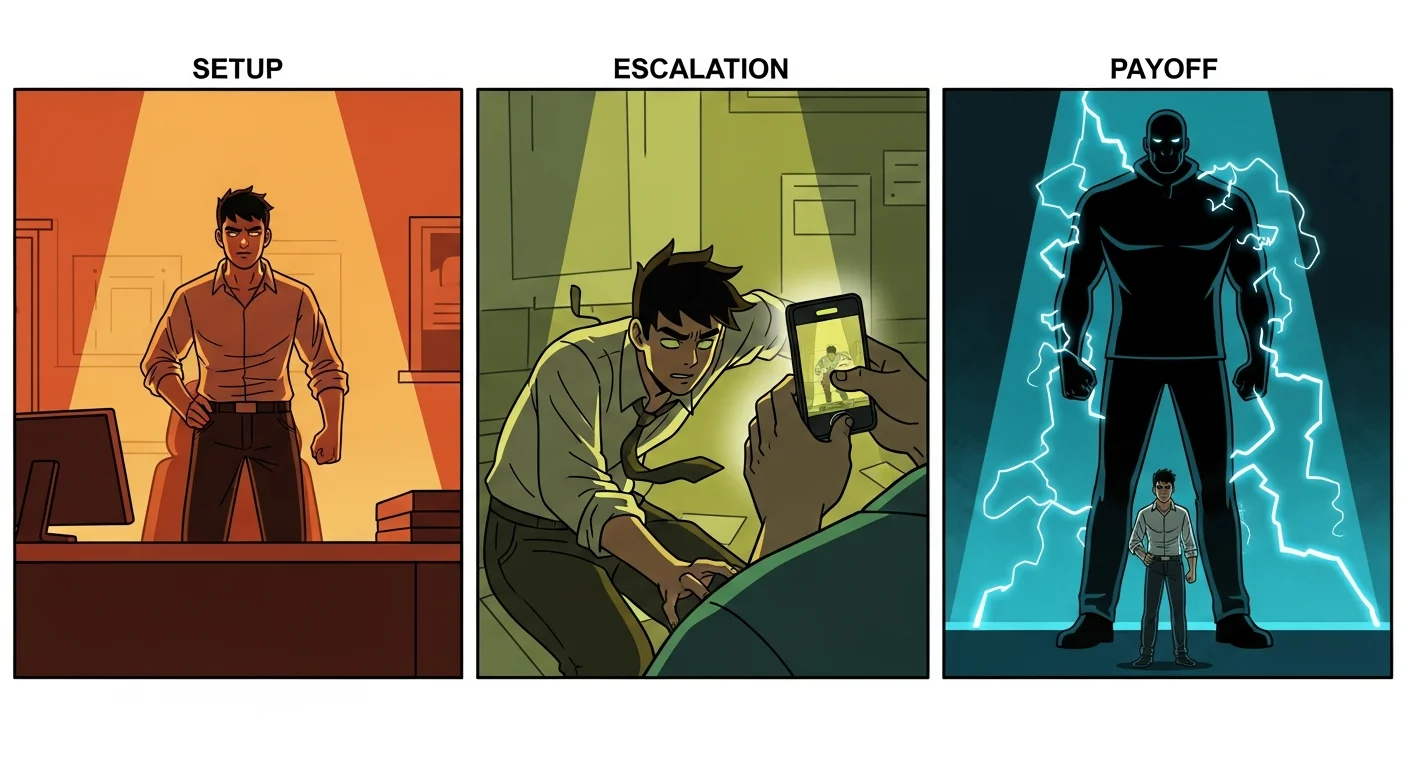
The beat structure of a karma comic is simple to state and hard to execute: setup the wrong, escalate the stakes, pay off with a consequence that is proportional and ironic. The difficulty is not in understanding the structure — it is in making each beat earn the next. The craft question is how to write each beat so the payoff lands with the force the setup promises.
In short: A karma comic has three beats — setup (40%), escalation (30%), payoff (30%). The payoff earns its satisfaction from an irony link: the wrongdoer’s own tool becomes the mechanism of their consequence. Script the irony link before writing a single panel.
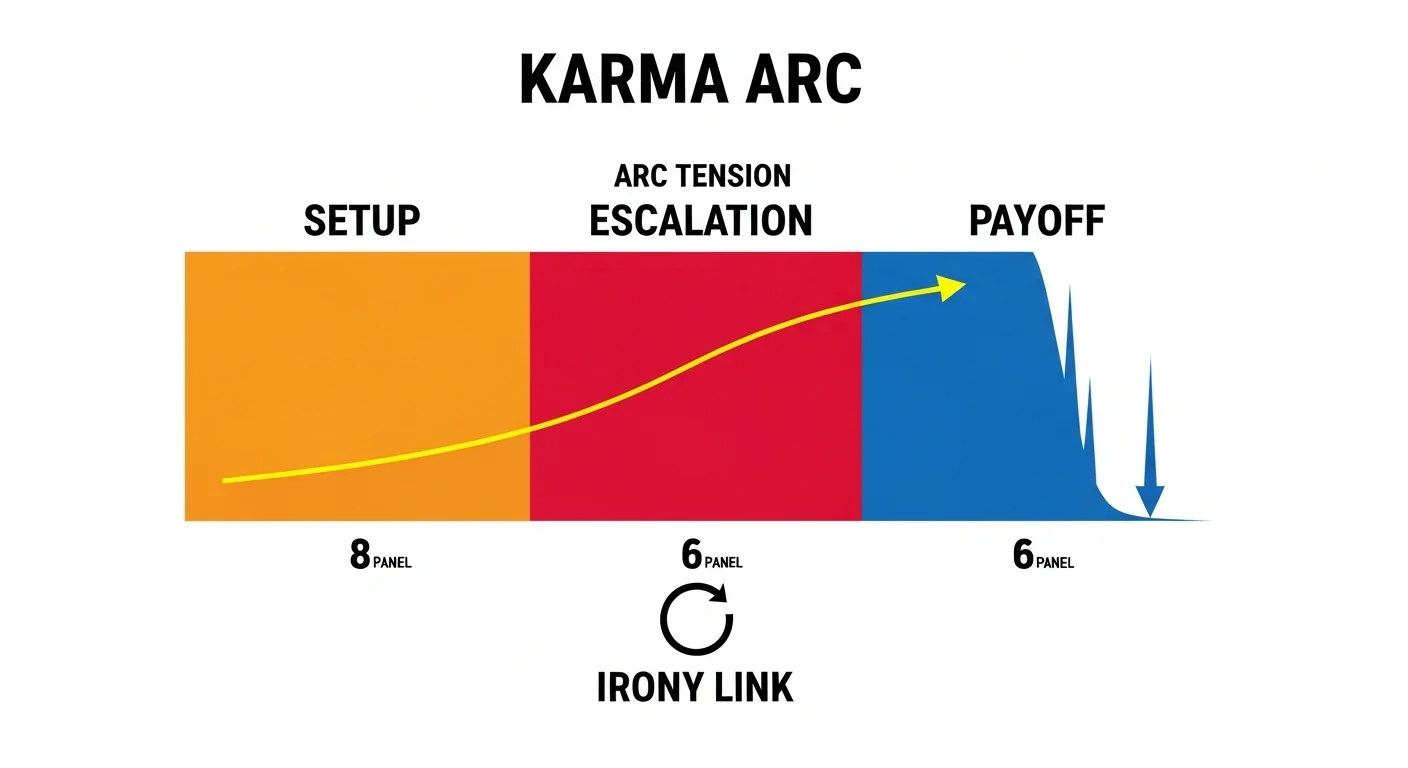
What Is the Beat Structure of a Karma Comic?
The setup-escalation-payoff structure is not unique to karma comics — it is the three-act pattern that underlies almost all short narrative forms. What makes karma comics distinct is that the structure has a specific constraint: the payoff must connect causally and ironically to the setup through what is called the irony link.
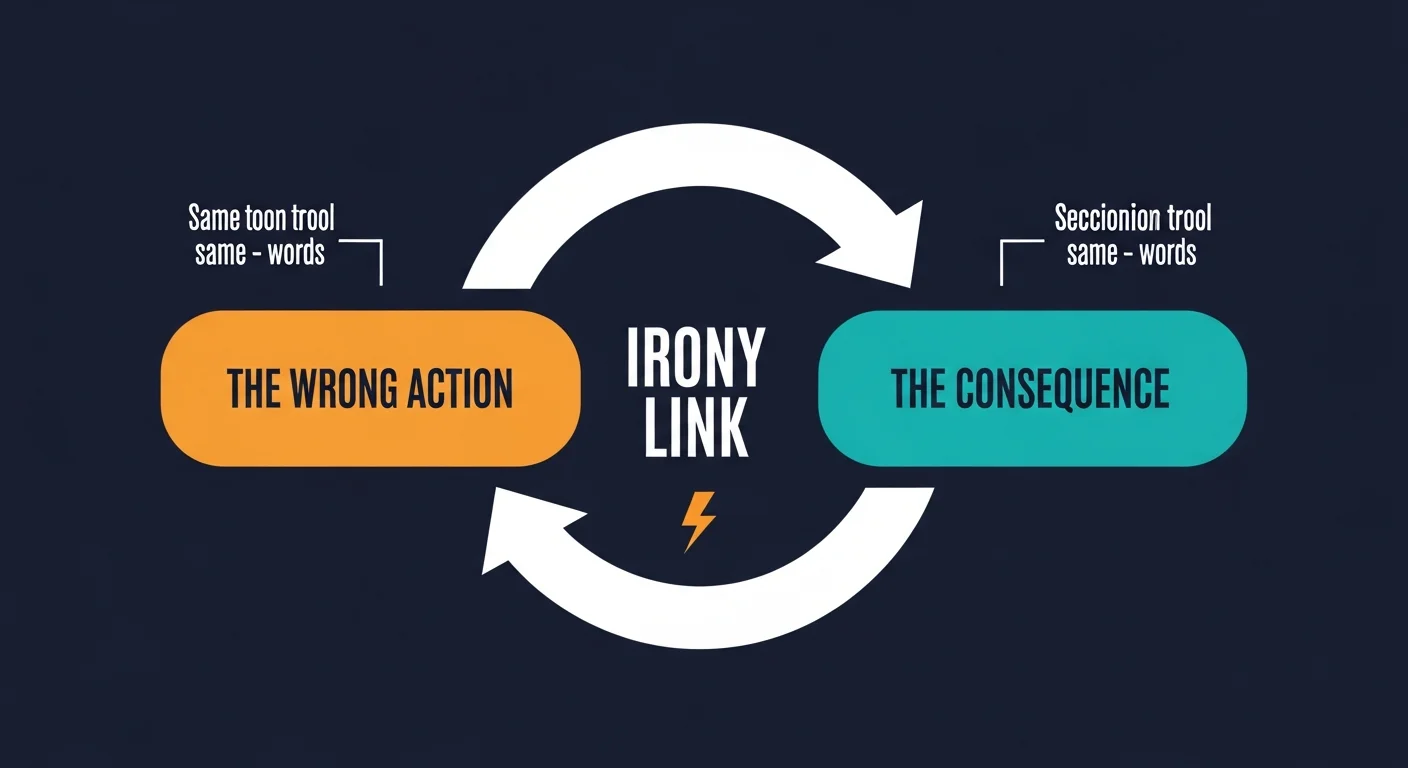
Without the irony link, you have a story where something bad happens to someone who did something bad. That is not a karma comic — it is a sequence of events. The irony link transforms the sequence into a closed loop: the wrongdoer’s own action or advantage becomes the mechanism that undoes them.
This is a craft constraint, not a plot convenience. It requires identifying the irony link during planning, before scripting begins. Writers who discover the irony link in the middle of scripting usually have to rewrite the setup to plant the mechanism. Writers who lock the irony link first write setups that are already building toward the payoff from panel one.
The beat structure works at any scale. A 12-panel short, a 30-panel episode, and a 5-episode mini-series all use the same 40/30/30 proportion — the structure scales with total panel count. The scripting discipline at each beat changes with format, but the architecture does not.
Why Does the Setup Determine Whether the Payoff Lands?
A karma comic’s payoff can only be as strong as its setup makes it. This is the most misunderstood principle of the genre. Creators instinctively want to write toward the payoff — the satisfying moment — and rush through the setup to get there. The result is a payoff that lands weakly because the audience has not had time to establish the wrong as real, specific, and unfair.
The setup has two jobs: it must make the wrong feel concrete and personal, and it must establish the wrongdoer’s confidence that they have faced no consequence. Both jobs are necessary. A wrong without confidence has no height to fall from. Confidence without a concrete wrong produces a villain who feels vague and therefore easy to dismiss.
The setup also plants the irony link — usually in the final setup panel, visible to the reader but not registered by the wrongdoer. A recording they do not notice. A witness they have dismissed. A document they created. This planted seed is what transforms the escalation beat into dramatic irony rather than simple repetition.
For more on how this craft connects to the build process in practice, the pillar guide on building teach-you-a-lesson comics covers the step-by-step generation flow in Comistitch.
How Do You Write a Setup Beat That Earns the Payoff?
A strong setup beat follows four rules:
Show the wrong on-panel, do not narrate it. The reader must witness the harmful action happening in the scene, not read a caption describing it. “She told the whole team it was her idea” in a caption is much weaker than a panel showing her at a whiteboard with the original creator’s notes crossed out, smiling at the client.
Keep the setup dialogue spare. One to two lines per panel maximum. The wrongdoer’s dialogue in the setup should reveal their character, not explain the situation. What they say should sound plausible or even charming to anyone who does not know the full truth — which is exactly how real wrongdoers behave.
End the setup with the wrongdoer confident. The last setup panel shows them unchallenged, comfortable, unaware of any consequence. This is the height from which the payoff drops them. The taller the confidence, the more satisfying the fall.
Plant the irony link seed. In the final setup panel or the panel just before it, place the mechanism of the eventual consequence in frame — but let the wrongdoer ignore it. A background detail, an unread notification, a person walking away. The reader sees it; the wrongdoer does not.
What Makes an Escalation Beat Work?
The escalation beat serves two simultaneous functions: the wrongdoer continues or compounds their behavior, and the consequence mechanism advances one step closer to activation — without the wrongdoer noticing.
The dual function is what creates dramatic irony, and dramatic irony is what gives the escalation beat its tension. The reader is ahead of the wrongdoer: they can see the collision coming. This gap between what the wrongdoer knows and what the reader knows is the engine of the escalation beat. Without it, the middle of a karma story is just more bad behavior with no forward momentum.
Common escalation mistakes:
- Introducing new characters or plotlines. The escalation beat should use only what the setup established. New elements dilute the irony link and weaken the payoff.
- Letting the wrongdoer feel doubt. A wrongdoer who starts to feel bad during escalation is building toward redemption, not karma. If redemption is not the ending, do not introduce it.
- Making the consequence mechanism too obvious. The irony link seed should advance, but the wrongdoer and any bystander characters should not see it coming. If they see it, the payoff is expected rather than sudden.
How Do You Write the Payoff Beat?
The payoff beat is the consequence arriving through the irony link. Three elements make it work:
The irony link is visible. The audience should immediately recognize that the wrongdoer’s own tool caused this. If viewers need to think about it, the connection is too indirect. The more transparent the irony, the more satisfying the payoff.
The consequence is proportional. A wrongdoer who humiliated someone publicly should face public exposure, not a quiet private consequence. Scale the consequence to match the scale of the wrong. Outsized consequences feel like punishment; proportional consequences feel like justice.
The reaction beat closes the story. After the consequence arrives, the payoff beat needs one or two panels of the wrongdoer processing what has happened. This is the emotional peak of the whole story. The moment of realization — or denial, or deflation — is almost always more satisfying than the consequence event itself. End the strip on this beat. Do not add commentary.
For the generation workflow that brings the payoff beat to screen, Part 3 of this series shows finished examples with panel descriptions and the publish flow.
The Beat Table: Karma Story Types by Structure
The 40/30/30 proportions hold across story types, but the scene content of each beat varies by the kind of wrong and the irony link:
| Story type | Setup beat | Escalation beat | Payoff beat | Irony link |
|---|---|---|---|---|
| Workplace | Manager claims credit in front of client | Manager presents the work again at a larger event | Original creator’s timestamped files surface in a skip-level meeting | The authority used to silence the team is overridden by the exact evidence chain it created |
| School / campus | Student copies another’s work and submits first, accusing the original author | Accuser escalates complaint, demands review | Review finds the original draft with timestamps; accusation reverses | The complaint process the accuser weaponized exposes them instead |
| Social / friendship | Friend habitually takes advantage of generosity, then brags about it | Friend repeats the pattern with a wider audience | Friend needs the same generosity urgently; discovers the bridge was burned publicly | The bragging that felt safe becomes the evidence of bad faith |
| Public / viral | Someone publicly mocks a person’s skills or work | The same person shares the mockery more widely | The mocked work surpasses the mocker’s — in public view | The amplification the mocker created becomes the stage for the person they underestimated |
These are structural templates. The specific scenes, characters, and dialogue are yours to invent — what matters is that the irony link column is filled in before you write a single panel.
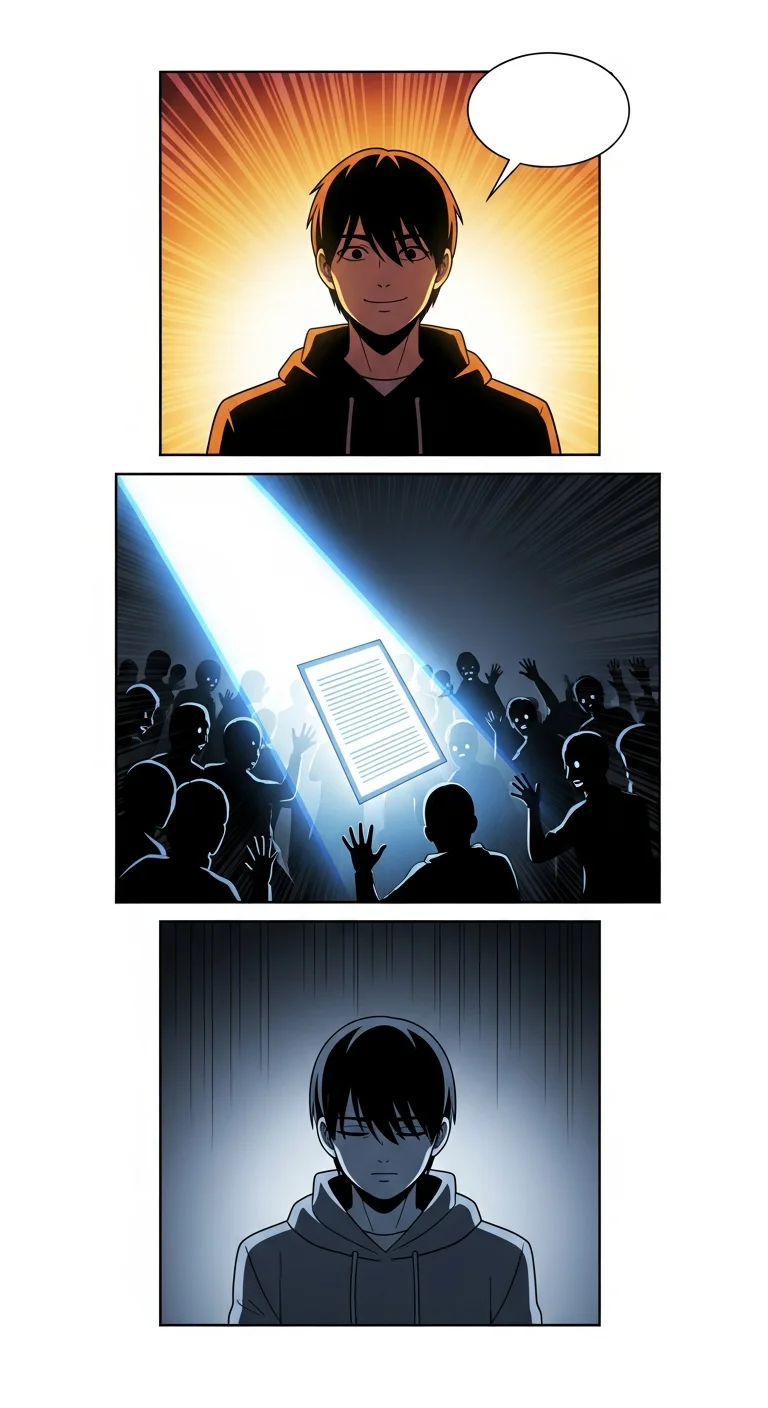
Comistitch Studio prompt — 10-panel karma short (workplace arc, 40/30/30 structure)
Paste the character anchor into every panel prompt unchanged to hold appearance stable across the full arc.
Character anchor: manager — charcoal blazer, silver pen, confident posture.
Original character — dark jacket, canvas bag, composed expression.
Style: full-color webtoon, manhwa-quality expressive linework.

Setup (panels 1–4, 40%):
Panel 1: Corporate meeting room. Manager presents slides to clients at a glass table.
Original character enters the doorway behind them, expression shifting from tired to stunned.
Cold screen-light on manager, warm hallway backlight on original character.
Panel 2: Wide office floor — manager accepts congratulations. Background: original character
reviews timestamped files at their desk, expression neutral.
Panel 3: Manager texts confidently in a corridor. Corner of frame: original character
photographs a monitor screen, back turned, phone raised.
Panel 4: Larger conference room, bigger audience, same slides. Through the glass partition:
a third figure watches silently, expression unreadable.

Escalation (panels 5–6, 30%):
Panel 5: HR corridor — manager walks toward a glass-walled office, unaware the third figure
is already seated inside.
Panel 6: HR doorway — manager stops. Original character seated across the table from the
third figure. Laptop open between them on the desk.

Payoff (panels 7–10, 30%):
Panel 7: HR table wide shot. Laptop screen shows a timestamped document chain.
Manager's posture deflates mid-step.
Panel 8: Close-up on laptop screen — file timestamps, version history, original authorship
unmistakable.
Panel 9: Close-up on manager's face. The exact moment of understanding. No dialogue.
Panel 10: Empty office chair at manager's desk. Through glass wall, original character
presents at a whiteboard in warm, confident light. No caption.
How Do You Pace a Karma Comic by Panel Count?
Pacing in a karma comic is entirely structural. Once the beat proportions are set and the irony link is locked, pacing follows automatically from panel count:
| Format | Total panels | Setup | Escalation | Payoff |
|---|---|---|---|---|
| Short (mini-episode) | 12 | 5 | 4 | 3 |
| Standard episode | 24 | 10 | 7 | 7 |
| Long episode | 32 | 13 | 10 | 9 |
| Mini-series (per episode) | 15 × 3 ep | Episode 1 | Episode 2 | Episode 3 |
The AI Webtoon Creator style in Comistitch generates panels for vertical-scroll format, where the reader controls pacing by scrolling speed. This gives the creator exact control over reveal timing from inside the builder — the payoff panel sits below the fold until the reader scrolls to it, which is a pacing advantage unique to the webtoon format.
For romance or school genre karma stories, the romance webtoon guide covers how pacing and emotional beat management work in character-relationship formats that share structural DNA with karma comics.
What Common Scripting Mistakes Break the Beat Structure?
Starting the escalation too early. The setup must fully establish the wrong and the wrongdoer’s confidence before the escalation begins. A creator who escalates in panel three has not given the audience time to feel the unfairness of the wrong, which means the payoff has nothing to pay off.
Writing a consequence that is not ironic. The wrongdoer gets fired for budget reasons unrelated to the wrong they committed. Technically a bad outcome — but the audience feels cheated because the irony link is missing. Every consequence in a karma comic must trace back to the wrong with a visible causal chain.
Closing on commentary instead of reaction. A narrator caption explaining “justice was served that day” kills everything that came before it. The reaction beat is the close. Trust the craft, trust the reader, and let the wrongdoer’s face do the final work.
Neglecting the AI Manhwa Generator style for high-stakes payoffs. The heavier ink weight and contrast in manhwa aesthetics amplifies the visual impact of a confrontation payoff panel in ways that a softer webtoon style does not. Matching the style to the intensity of the consequence is a craft decision as much as an aesthetic one.
Frequently Asked Questions
What is the setup beat in a karma comic? The opening act — roughly 40% of panels — that establishes the wrongdoer’s harmful action concretely and shows them confident that no consequence has followed. It must plant the seed of the irony link in the final setup panel, visible to the reader but ignored by the wrongdoer.
What is the escalation beat in a karma comic? The middle act where the wrongdoer continues or compounds their behavior while the consequence mechanism advances without their awareness. It creates dramatic irony: the reader sees the collision coming; the wrongdoer does not.
What makes a payoff beat satisfying? Three things: an irony link that is immediately visible, a consequence proportional in scale to the original wrong, and a reaction beat where the wrongdoer processes what has happened. The reaction beat is usually more emotionally resonant than the consequence event itself.
How do I find the irony link in my karma story? Ask what tool or advantage the wrongdoer used to commit the wrong. Then ask how that same thing could be turned against them. Lock the irony link in writing before scripting any panels — it determines the entire setup.
How many panels should each beat take? Use 40/30/30 proportions across total panel count. A 24-panel episode splits into roughly 10 setup, 7 escalation, 7 payoff. Scale the number up or down; keep the proportions.
Can the same beat structure work across a multi-episode series? Yes. In a three-episode mini-series, each episode handles one full beat: episode 1 is setup, episode 2 is escalation, episode 3 is payoff. The irony link becomes a slow-burn revelation built across chapters, which requires stronger character consistency across episodes.
This is Part 2 of the Teach-You-a-Lesson Series. Return to Part 1 — How to Make a Teach You a Lesson Comic with AI for the full build guide, or continue to Part 3 — Showcase and Publish for original story examples and the platform launch flow.
Related reading