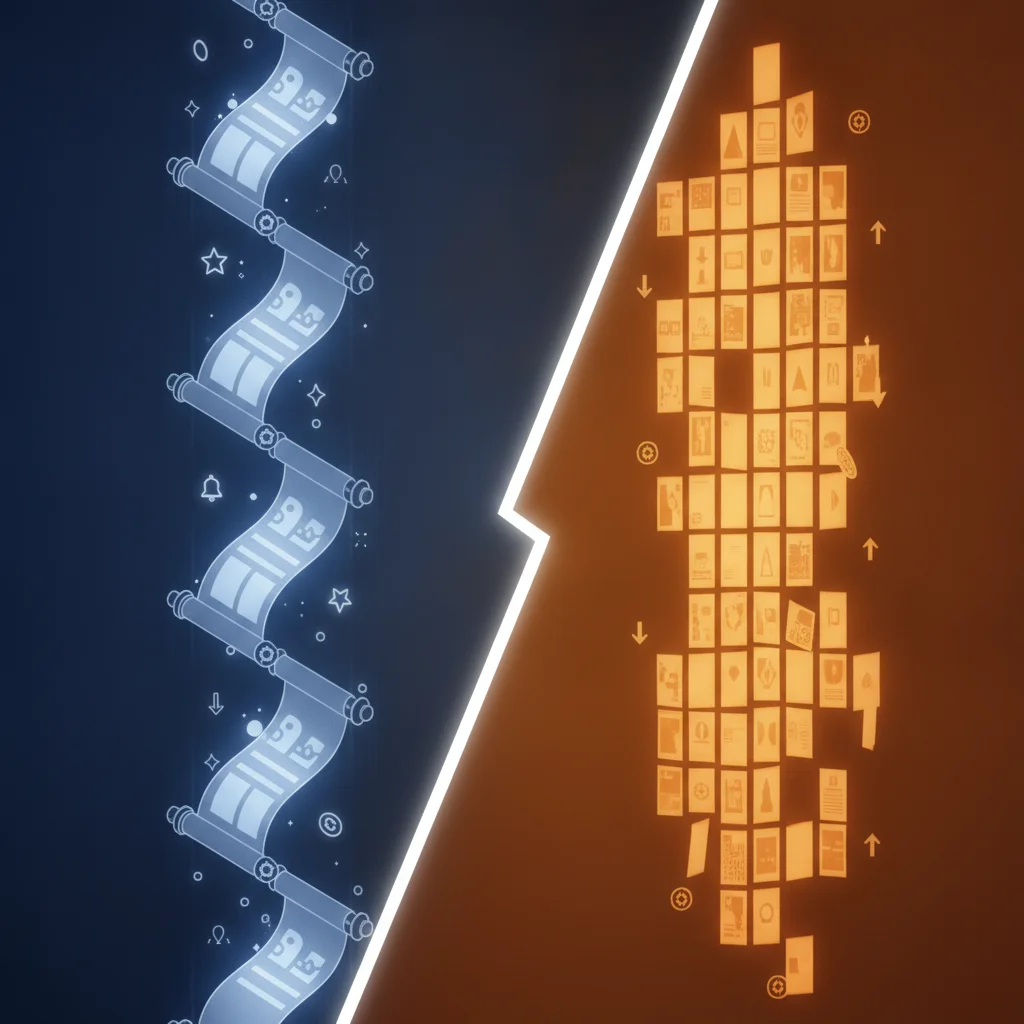
In short: publish on WEBTOON Canvas if your comic is vertical-scroll and your problem is finding readers. Publish on GlobalComix if your comic is page-format and your problem is getting paid. The thing that decides it is not quality or ambition — it is your page format and which scarcity you are short of, readers or revenue per reader. If your artwork is fully AI-generated, GlobalComix will host it but will not let you monetise it; Canvas currently has no AI clause at all.
GlobalComix vs WEBTOON at a glance
| WEBTOON (Canvas) | GlobalComix | |
|---|---|---|
| Audience scale | Hundreds of millions of monthly users platform-wide | High hundreds of thousands of accounts |
| Native format | Vertical scroll, episode-based | Page-format and vertical, reader supports both |
| Discovery | Strong — recommendation feed, genre charts, contests | Weak — genre browsing plus your own promotion |
| Who pays you | Ads, after a subscriber and page-view threshold | Gold subscription split, paid releases, PDF sales, donations |
| Paid from reader #1? | No | Yes |
| Published revenue share | Share of net ad revenue, rate not published | 65% free plan, 70% Pro plan on subscription revenue; 92–95% of donations |
| Payout minimum | US $25 to PayPal (lowered Jan 2026) | US $30 |
| Creator cost | Free | Free tier; a paid Pro plan raises the share and adds tools — check their pricing page for the current rate |
| Rights on the self-publish tier | You own it; platform gets a hosting licence | You own it; platform gets a hosting licence |
| Exclusivity risk | Only if you sign an Originals contract | No equivalent IP-taking tier |
| AI-generated art | No policy clause as of Sept 2026 | Disclosure required; fully AI visuals not allowed; AI work not monetisable |
| Best for | Weekly scroll serials chasing an audience | Page comics and graphic novels chasing revenue |
Terms verified against each platform’s public pages in September 2026. Both change them — check globalcomix.com and webtoons.com before you commit.
The verdict, and exactly what it depends on
Every honest answer to “which platform should I publish on” is conditional. Here is the condition, stated so you can apply it in thirty seconds.
Question 1 — what shape is a page of your comic? If a chapter reads as one continuous column with the gutter doing the pacing, you are making a webtoon and WEBTOON Canvas is your home platform. If a chapter reads as composed pages — spreads, splash pages, full bleeds — then vertical scroll actively destroys your layout, and GlobalComix’s page reader is the only one of the two that shows the work as drawn.
Question 2 — what are you short of? If you have no readers, the audience gap between these two platforms is not a detail, it is the entire decision: WEBTOON’s platform-wide audience is roughly three orders of magnitude larger than GlobalComix’s. If you already have a mailing list, a Discord, or a following from another platform, GlobalComix converts that attention into money far earlier, because it splits subscription revenue with you from your first paying reader instead of after a threshold.
Question 3 — how was the art made? This one overrides the other two for a growing number of creators, and we cover it in full below.
If you want the wider field rather than this head-to-head — Tapas, self-hosting, Ko-fi, itch.io and the rest — we rank all of them in best platforms to publish webcomics in 2026, and there is a branching version in the AI comic publishing decision tree. This post only compares these two.
Audience and discovery: the gap is real, but it is not free
WEBTOON’s advantage is the recommendation surface. A Canvas series is eligible for genre charts, the “new and trending” rails, staff picks and the platform’s contests, and a series that lands in those can go from a few hundred subscribers to five figures inside a season. In 2026 WEBTOON also unified its international Canvas platform, distributing self-published series across additional languages rather than siloing them per region, which widens the pool a single upload can reach.
The part nobody advertises: most Canvas series never surface at all. The feed rewards weekly consistency over months, thumbnail quality, and genre fit with what the platform is currently pushing. A Canvas series updated irregularly is functionally invisible, and no amount of art quality fixes that. Growth on Canvas is a schedule problem before it is an art problem — the mechanics are the same ones we break down in how to grow your manhwa audience.
GlobalComix is the opposite trade. There is no feed that will hand you ten thousand readers, so almost all of your growth comes from genre browsing, the paid-subscription library, and traffic you bring yourself. In exchange, the readers there arrived to read comics specifically, a meaningful share of them pay for a Gold subscription, and page-format indie work is not competing against a wall of romance vertical scrolls for attention.
Expected growth, stated plainly: larger raw numbers on WEBTOON, higher value per reader on GlobalComix. If you are choosing on audience-growth potential alone, WEBTOON wins and it is not close. If you are choosing on revenue per reader, the ordering flips.
Monetisation: when each platform starts paying
WEBTOON Canvas monetisation is threshold-gated. Ad revenue sharing requires a qualifying audience — reported at roughly 1,000 subscribers and 40,000 monthly page views as of 2026 — after which you receive a share of net ad revenue, with no published per-view rate. Creators in the program can lock a limited number of recent episodes behind reward ads (raised to six episodes in January 2026), and the PayPal payout minimum was cut from $100 to $25 at the start of 2026. Everything before that threshold pays nothing, which is why most Canvas creators run an external tip jar in parallel.
GlobalComix monetisation is share-based and starts immediately. Its published creator terms are a 65% content revenue share on the free plan and 70% on the paid Pro plan, paid out of the Gold subscription pool in proportion to how much of a subscriber’s reading your titles accounted for, plus paid releases, PDF sales and donations at a 92–95% creator share. The payout minimum is $30.
Read that difference as a curve, not a winner. Below a thousand subscribers, GlobalComix pays more because Canvas pays zero. Well above it, WEBTOON’s sheer traffic outruns a percentage of a much smaller subscription pool. The crossover point depends on your genre and how much of your readership pays, which is why the split-and-mirror strategy in how to make money with manhwa usually beats picking one and hoping.
Rights: what you keep on each
On both self-publishing tiers you keep ownership and grant a hosting and display licence. Neither Canvas nor GlobalComix takes your IP for the privilege of uploading.
The divergence is one tier up. WEBTOON Originals is a contract: editorial support, an advance and episodic payments in exchange for exclusive worldwide digital rights for a defined term, typically with options on print and screen. That is a genuinely good deal for some creators and a bad one for others, and it is the single biggest structural difference between these platforms, because GlobalComix has no equivalent tier that acquires your rights. We break the two WEBTOON tiers apart in WEBTOON Canvas vs Originals.
Upload format: what each one actually accepts
Canvas expects vertical-scroll episodes — a tall image column, conventionally around 800 px wide, sliced into manageable segments, uploaded per episode with a thumbnail. Page spreads uploaded to Canvas get scaled down to column width and read badly on a phone.
GlobalComix accepts both page-format releases and vertical uploads, organised as series and releases with their own covers and pricing, which is why painted and Western-style page work — the sort of output the painted graphic novel style produces — lands there intact.
If you are exporting from Comistitch, this is a format choice rather than a re-draw: the same project exports vertical-scroll for Canvas and page spreads for GlobalComix, which is the workflow in turning an AI comic into a webtoon. Pick the platform by what your story wants to be, then export to fit it.
If your art is AI-generated, this is the deciding factor
This is the part where we have an obvious interest, so here are the rules as published rather than as we would like them.
GlobalComix. Its AI policy (read September 2026) requires disclosure of AI use for art and for story during upload. Work whose visuals are produced fully from generative AI prompts is not allowed; AI used as one tool within a broader human creative workflow is. AI content is not eligible for monetization — explicitly including Gold subscription revenue and PDF sales — and the donation button is disabled on releases using AI art. The policy also asks creators planning a generative-AI upload to email support for review, and reserves the right to ask which tools were used.
WEBTOON Canvas. As of September 2026 neither the Canvas terms nor the community policy carries an AI-artwork clause, and the uploader has no AI disclosure field. WEBTOON’s contests are governed separately and have disqualified generative-AI submissions. WEBTOON has also stated that its AI translation program does not train on creators’ artwork.
So for a fully AI-generated series the answer is not balanced: Canvas will host and potentially monetise it; GlobalComix will host it but not pay for it. For an AI-assisted series where you are drawing, inking or substantially reworking the output, GlobalComix’s policy is written to permit monetisation — but that judgement is theirs, made per upload, so ask before you build a release schedule on it. Both policies are young and both will move; treat anything in this section as a prompt to re-read the source page, not as a settled fact.
Publishing to both
Canvas and GlobalComix are both non-exclusive, so cross-posting is permitted and common. The practical version:
- Pick one primary based on format — the platform whose reader shows your pages as composed.
- Mirror to the second on a delay of a few episodes, so the primary keeps the first-look traffic.
- Own the endpoint. A newsletter or your own site is the only audience neither platform can rank you out of.
- Keep one master project. Re-lettering a series twice is how cross-posting dies in month three — export both layouts from the same source, don’t rebuild.
A title that survives a genre chart helps on both; if you are still naming the thing, the webtoon title generator is a faster way through that than another evening of lists. When the script and layout are ready, the AI webtoon creator style exports vertical-scroll episodes and page spreads from the same project, so the format decision above stops being a re-draw decision.
Bottom line
Format decides the platform; scarcity decides the strategy. Vertical-scroll serial with no audience yet, WEBTOON Canvas. Page-format comic or graphic novel with even a small existing following, GlobalComix. Fully AI-generated art, Canvas by elimination, because GlobalComix will not monetise it. And if the honest answer for your project is “both”, publish to both — nothing in either platform’s self-publish terms stops you.
External references
- GlobalComix AI policy — disclosure requirements and monetization eligibility, read September 2026
- GlobalComix creator plans — current revenue share per plan tier
- WEBTOON Canvas community policy — what Canvas permits
- Related reading: webcomic platforms ranked for 2026 · WEBTOON Canvas vs Originals · publishing on WEBTOON and Tapas