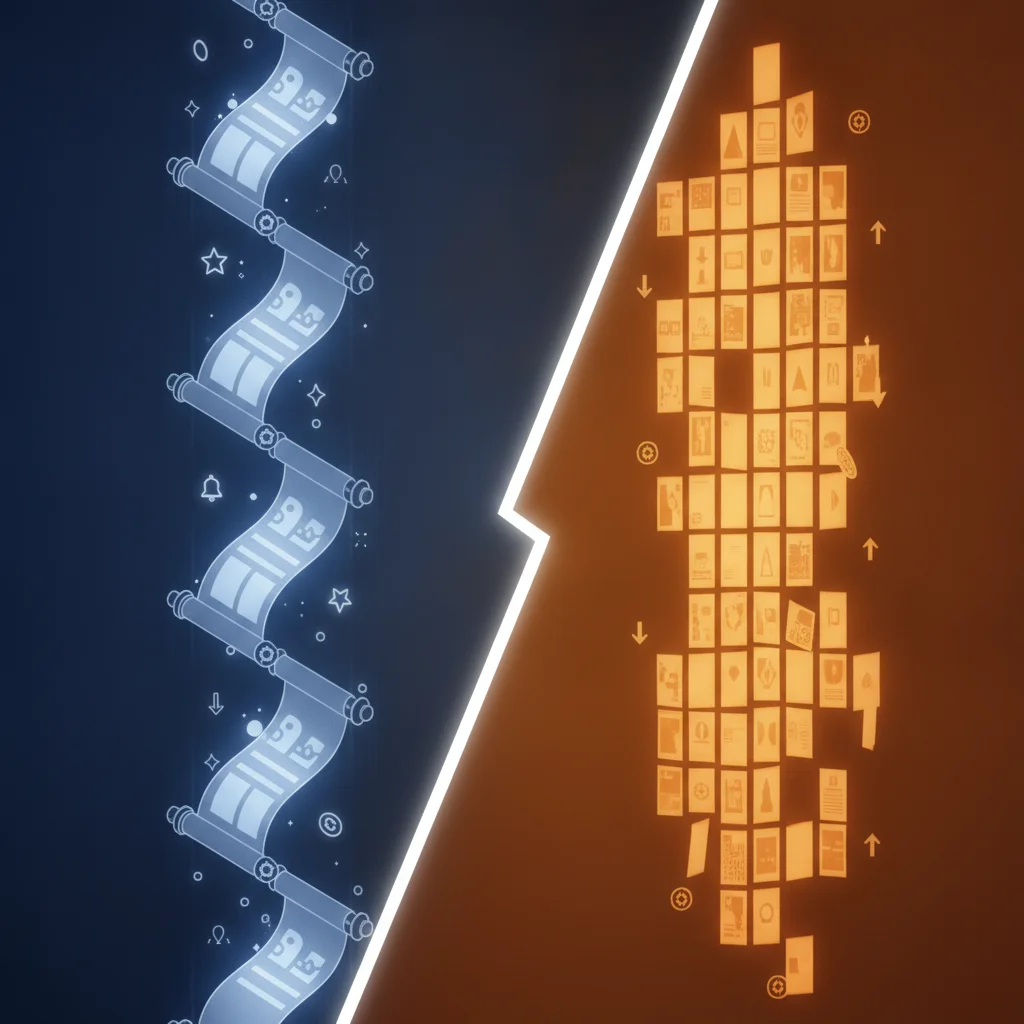
In short: Canvas is WEBTOON’s open self-publish tier — upload anything, keep your rights, get paid nothing until roughly 1,000 subscribers and 40,000 monthly page views admit you to ad revenue sharing. Originals is the contracted tier — an advance, episodic pay, editorial and marketing support, in exchange for exclusive worldwide digital rights for a term. You do not choose between them: you start on Canvas, and Originals is something you may be offered later. As of September 2026 Canvas has no AI-artwork policy clause at all, which makes it the most permissive large platform for AI-assisted comics — and the least predictable.
Canvas vs Originals at a glance
| Canvas | Originals | |
|---|---|---|
| How you get in | Upload — no approval needed | Editorial invitation or contest win |
| Upfront pay | None | Advance plus episodic payments |
| Ongoing pay | Ad revenue share after threshold | Contracted rate, plus Fast Pass and ad revenue |
| Threshold to earn | ~1,000 subscribers + ~40,000 monthly views | None — you are contracted |
| Editorial support | None | Editor, art notes, production schedule |
| Marketing | Genre listings and the Canvas feed | Front-page placement and campaigns |
| Schedule | Your own | Contractual, usually weekly |
| Exclusivity | None — cross-post freely | Exclusive worldwide digital rights for a term |
| Rights | You own; platform licence to host | You own; platform takes broad exclusive licence plus options |
| Payout minimum | US $25 via PayPal since Jan 2026 | Per contract |
| AI artwork policy | No clause as of Sept 2026 | Per contract and editorial direction |
| Realistic timeline | Immediate | 6–24 months of weekly Canvas uploads, if ever |
Figures reflect WEBTOON’s public creator notices and press announcements as of September 2026. Thresholds and programs change — check WEBTOON’s creator docs before planning around any number here.
What Canvas actually is
Canvas is the tier that makes WEBTOON an open platform rather than a publisher. You create an account, upload a vertical-scroll series, set a thumbnail and genre, and it is live — no submission queue, no editor, no contract. Your series appears in Canvas genre listings and becomes eligible for the recommendation surfaces, and readers can subscribe, rate and comment exactly as they do on contracted series.
Two facts about Canvas that new creators consistently get wrong:
It is not a lesser format. Canvas series use the same vertical scroll reader, the same subscriber mechanics and the same comment threads as Originals. The reader experience is identical; what differs is placement and money.
It is not exclusive. Nothing in Canvas stops you mirroring the same episodes to Tapas, GlobalComix or your own site. Creators lose years assuming otherwise.
In 2026 WEBTOON also unified its international Canvas platform, distributing self-published series across several languages rather than keeping regional Canvas pools separate, alongside an AI-powered translation program for creator series. That widens the audience a single upload can reach — and WEBTOON has stated the program translates text rather than training on creators’ artwork.
What Originals is, and what it costs
Originals is the contracted lineup: series selected by WEBTOON’s editorial team, given an advance and episodic payments, an editor, production support and the marketing placement that fills the app’s front page. Publicly reported monthly stipends for new Originals creators have ranged in the low thousands of dollars, with additional revenue from Fast Pass early-access unlocks and ads.
The cost is the contract. Originals agreements grant exclusive worldwide digital rights for a defined term — commonly reported as three years after the final episode — plus options on print and audiovisual adaptation. That structure has drawn sustained public criticism from creators, and it is worth understanding before you want it: you are trading the ability to license your own IP for a guaranteed production income.
Neither side of that trade is wrong. A creator who wants to be paid to make comics full-time is getting exactly what they asked for. A creator whose plan is to build IP and license it themselves is signing away the plan.
How Canvas creators actually make money
Canvas monetisation is a stack, and most of it is not WEBTOON’s.
Ad revenue sharing. The core program. Reported qualification as of 2026 is roughly 1,000 subscribers and 40,000 monthly page views, after which the series shares net ad revenue. WEBTOON does not publish a per-view rate, so every earnings figure you have seen from another creator is an anecdote about their genre, region and read-through, not a rate you can forecast from.
Reward ads. Creators in the ad program can lock recent episodes behind a rewarded ad — raised from three episodes to six in January 2026. This is the closest Canvas gets to a Fast Pass: readers trade attention instead of coins for early access.
Payout threshold. The PayPal minimum dropped from $100 to $25 on 5 January 2026. For a small series this is the difference between collecting earnings this quarter and watching them sit in an account for two years. Patreon-routed payouts have kept a higher minimum, so check which method your account uses.
Everything else. Tips, Patreon, Ko-fi, commissions, merchandise and print sales, all linked from your creator profile and episode descriptions. For most Canvas series below the ad threshold this is the entire income, which is why the external link in your description is not a nice-to-have. The full picture of stacking these is in how to make money with manhwa.
WEBTOON has also expanded Canvas creator programs through 2026 — a lower payout floor, wider reward-ad access, a monetisation dashboard and a creator residency program. The direction of travel is toward paying self-published creators earlier. The threshold is still a threshold.
Moving from Canvas to Originals
There is no application that works. The three routes creators actually report:
- Traction the editors notice. Subscriber growth rate matters more than the raw count, and consistency matters more than either. Weekly uploads over six to twenty-four months is the shape of almost every reported invitation.
- Contests. WEBTOON runs short-story and genre contests with real prize money and a direct editorial pipeline. Note carefully: contest rules are separate from Canvas policy, and generative-AI submissions have been disqualified.
- Direct outreach. Editors do contact creators whose work fits a slate they are building.
What does not work: messaging editors, subscriber-count milestones treated as an entitlement, or a single viral episode without a back catalogue. If you are building toward this, treat the Canvas run as the audition it is — the webtoon pacing and cliffhanger techniques that hold weekly readers are the same ones that make a series look promotable.
WEBTOON’s AI-generated content policy
Creators using AI tools need a straight answer here, so here is the state of the published rules, stated as findings rather than as reassurance.
Canvas has no AI clause. As of September 2026, neither the Canvas Terms of Use nor WEBTOON’s community policy contains language about AI-generated or AI-assisted artwork, and the uploader has no AI disclosure field. There is no platform-wide ban and no mandatory AI label.
Contests are different. WEBTOON’s official contests have prohibited generative AI in submissions and disqualified entries found to have used it. A rule for contests is not a rule for Canvas, and the reverse is also true — do not assume Canvas permissiveness extends to a contest entry.
WEBTOON’s own AI use is narrow. Its translation program translates creator text and the company has stated it does not train on creators’ artwork.
Three things follow, and all three are practical:
- Disclose voluntarily. A line in the episode description saying which parts were AI-assisted costs nothing, pre-empts a reader pile-on, and puts you on the right side of a labelling rule if one arrives.
- Own what you upload. The absence of an AI clause does not soften the rules that already exist. Generated art that imitates another creator’s characters, style or likeness is an infringement question, not an AI question.
- Do not build a business on an unwritten rule. Policy silence is the most changeable state a policy can be in. Mirror your series somewhere you control — that is the whole argument of the AI comic publishing decision tree.
This section will age faster than the rest of this post. As of September 2026 it reflects WEBTOON’s published Canvas policy; check their creator docs before you launch.
Practical Canvas launch checklist
- Format to the column. Vertical-scroll episodes, conventionally around 800 px wide, sliced into segments the uploader accepts. Confirm current dimension and file-size limits in WEBTOON’s creator guide — they have changed before. The layout rules are in the vertical scroll paneling guide.
- Bank episodes before you launch. Three to five finished episodes in reserve is what keeps a weekly schedule alive through a bad month, and weekly is what the feed rewards.
- Write the description as a pitch. Genre, hook, schedule, and your tip-jar link. It is the only sales copy you get.
- Title it for a genre chart. A title has to survive being read in a 2-inch-wide rail next to forty others; the webtoon title generator is a faster way through that than another list.
- Set the schedule you can actually hold. Every-other-week kept for a year beats weekly abandoned in month two.
If you are producing episodes with AI assistance, the AI webtoon creator style exports Canvas-shaped vertical columns directly, and the webtoon script generator gets a scripted episode into that shape without a separate formatting pass. Consistency across a long run is the hard part — that is covered in webtoon character consistency with AI.
Bottom line
Canvas is not the waiting room for Originals — it is the platform, and for most creators it is the whole platform. Upload there because it is open, keep your rights because it is non-exclusive, mirror elsewhere because policy silence on AI is a temporary condition, and treat an Originals invitation as an offer to evaluate rather than a promotion to accept automatically. The threshold you are working toward is not a contract; it is roughly a thousand subscribers who show up every week.
External references
- WEBTOON Canvas community policy — what Canvas permits, and what it is silent on
- WEBTOON Canvas monetization notices — payout threshold and reward-ad changes
- WEBTOON unified international Canvas announcement — 2026 Canvas program expansion
- Related reading: GlobalComix vs WEBTOON for creators · webcomic platforms ranked for 2026 · publishing on WEBTOON and Tapas