Most homebrew settings die in a document nobody opens.
You spent months on the history of the Sundered Coast, and at session twelve a player asks which of the two kingdoms they are currently in. This is not a player failure. It is a format failure — you gave them an encyclopedia and expected engagement.
Show what they will touch
The filter for what deserves a panel is simple: will the party physically encounter this, or choose between versions of it?
| Illustrate | Keep in notes |
|---|---|
| Factions they will deal with | Dynastic succession three centuries back |
| Places they will visit | Continental geography they will never cross |
| The local fear or rumour | Cosmological structure |
| Ruins, borders, holy sites | Trade economics |
| What a soldier of each faction looks like | The names of every noble house |
Everything in the right column can stay in your notes and still shape your decisions as GM. It just should not be the material you hand players.
One panel, one idea
The most common mistake is cramming a paragraph of lore into a single image.
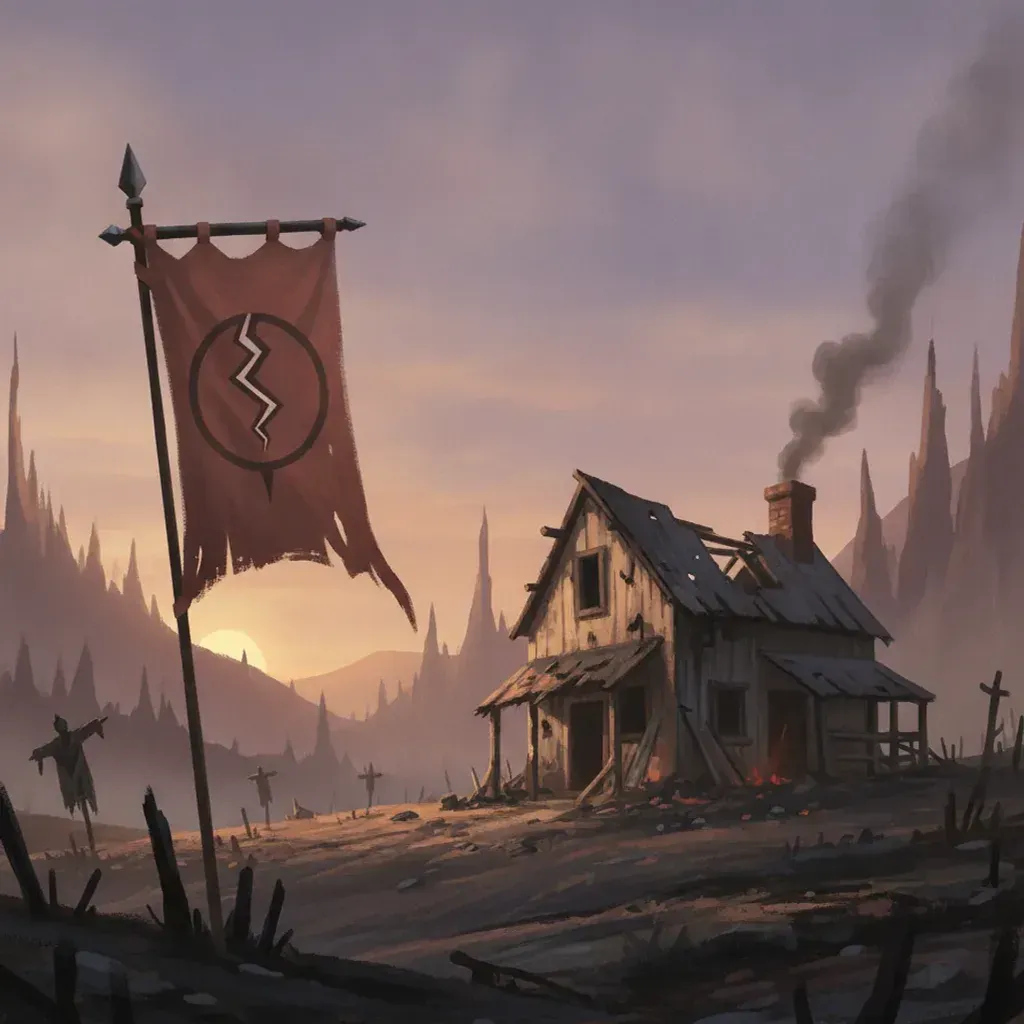
A panel showing a faction banner planted over a burned farmstead tells a player more about that faction than three paragraphs of description — because it commits to one idea. The reader takes away: these people came here, they burned it, they claimed it.
Add a second idea to the same panel and the first gets diluted. If you need three ideas, use three panels.
Factions are the highest-value target
If you illustrate one category of worldbuilding, make it factions.
Give each faction a visual identity:
- A dominant colour
- A symbol
- A recognisable soldier silhouette — heavy and armoured, light and hooded, uniformed and drilled
Once established, every later panel does free work. A patrol in the background wearing the wrong colour is a plot beat that needs no caption. Players who cannot recall a faction’s name will absolutely recall that they are the ones in rust-red with the split-circle banner.
This also solves the “which kingdom are we in” problem permanently — not by explaining it again, but by making it visible.
Reveal at the pace of travel
Front-loading a world is how lore documents get ignored. Instead:
Session zero — two or three panels. Enough to set tone and scale. The capital, the frontier, the thing everyone is afraid of. Not a tour.
On arrival — one establishing panel per new place. This is where most setting material should live. The party reaches the mining town; one panel shows what kind of place it is, and you have communicated more than a read-aloud paragraph would.
On consequence — a panel when the world changes. The border moves, the temple burns, the faction the party helped starts flying its banner over a town it did not hold before. These are the panels players remember, because the change is theirs.
Lock your locations
Locations drift the same way characters do. If the party returns to a place and it looks different, the world stops feeling real.
Lock each recurring location the way you lock a character:
- Materials — cut stone, rotted timber, whitewashed plaster
- Palette — the colours that dominate
- One landmark — a broken tower, a chained gate, a statue missing its head
Three details are usually enough. The landmark does most of the work; readers navigate by it.
Maps and panels do different jobs
A comic panel cannot replace a map, and should not try.
- Maps answer where and how far. Keep using them.
- Panels answer what is it like and why should I care.
A panel of a mountain pass at dusk with a watchtower burning in the distance will not tell anyone how many days’ travel it is. It will tell them the pass is contested, which is the part that changes their decision.
Use both. Do not ask either to do the other’s job.
Start with what the party is about to meet
Do not begin by illustrating your setting’s history. Begin with the faction or place your party will encounter in the next two sessions.
That material gets used immediately, you learn what works with your table before committing effort, and it never becomes a document nobody opens.
The setting grows out of play rather than in front of it — which is also, generally, how the good parts of a homebrew world get written.
Ready to make your setting visible? The AI D&D comic generator handles painted fantasy locations and factions, and campaign recap comics covers the cadence for getting this material in front of your table.