Shonen, shojo, seinen and josei are the four main Japanese manga demographics: labels for the readership a magazine is edited for, not genres. Shonen targets boys about 12 to 18, shojo targets girls the same age, seinen targets adult men and josei targets adult women. Each one carries action, romance, comedy and drama alike.
In short: the demographic is decided by the magazine a manga ran in, not by what happens in it. Age and gender of the intended reader shape tone, pacing and art conventions, but every demographic contains every genre — which is why “seinen means dark” and “shojo means romance” are both wrong.
This guide covers the comparison table, how each demographic differs on the page, the labels people get wrong, the small fifth category (kodomo), why manhwa and webtoon apps do not use any of this, and how to pick a target tone for a comic of your own. For a deeper dive into any single term, each has its own glossary page: shonen, shojo, seinen and josei.
Shonen vs seinen vs shojo vs josei at a glance
| Shonen (少年) | Shojo (少女) | Seinen (青年) | Josei (女性) | |
|---|---|---|---|---|
| Literal meaning | ”Boy" | "Girl" | "Young man" | "Woman” |
| Intended reader | Boys, ~12–18 | Girls, ~12–18 | Adult men, ~18+ | Adult women, ~18+ |
| Example magazines | Weekly Shonen Jump, Weekly Shonen Magazine | Ribon, Nakayoshi, Hana to Yume | Weekly Young Jump, Morning, Big Comic | Kiss, Feel Young, You |
| Well-known series | One Piece, Haikyu!!, Death Note | Fruits Basket, Ouran High School Host Club | Monster, Vagabond, Berserk | Nodame Cantabile, Chihayafuru, Princess Jellyfish |
| Typical story engine | A goal, rivals, training, growth | Relationships, feelings, identity | Work, institutions, moral grey areas | Adult relationships, careers, money, family |
| Pacing | Fast, chapter-end hooks | Emotional beats, interior time | Free to slow down | Measured, often retrospective |
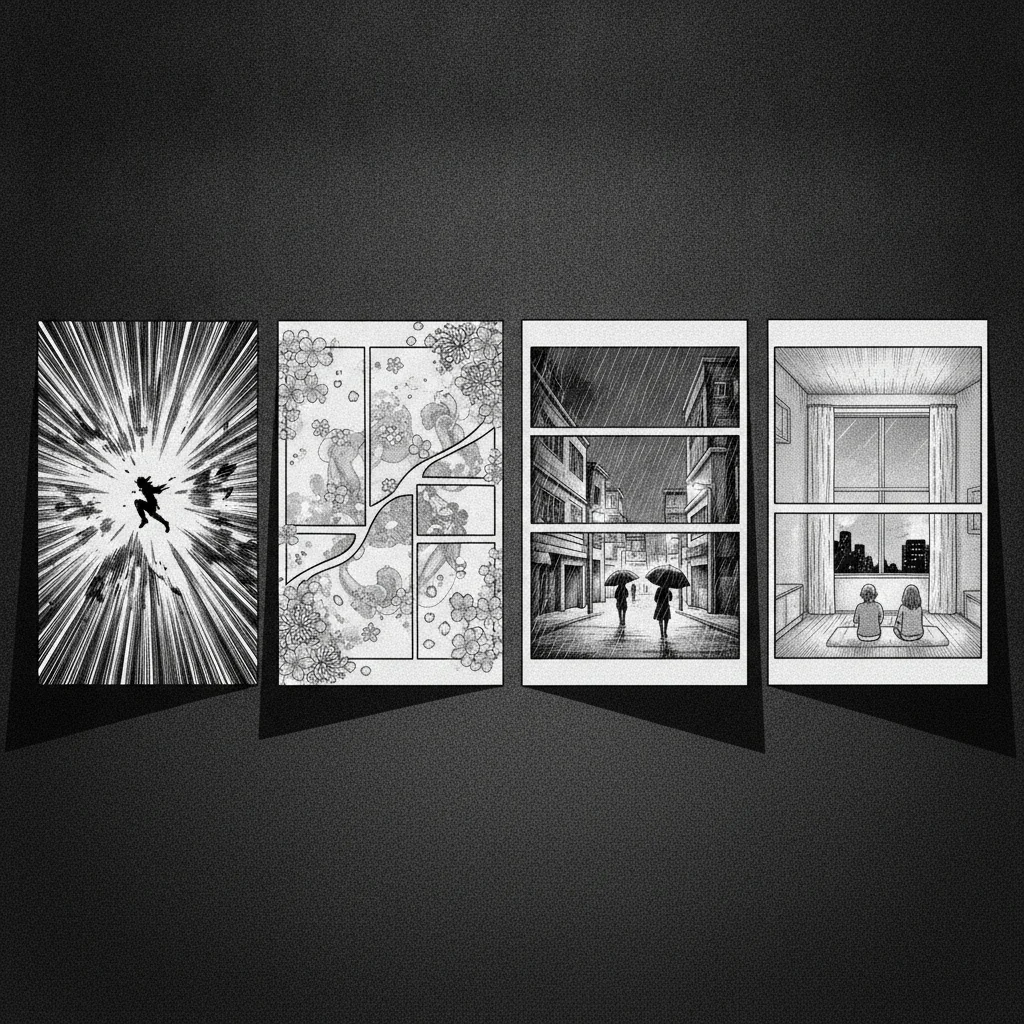
| Page grammar | Hard borders, speed lines, impact panels | Borderless panels, floral screentone, floating monologue | Wider, cinematic, denser backgrounds | Restrained, observational, closer to real proportions |
| Common mislabel | ”Shonen = action" | "Shojo = romance" | "Seinen = gore or explicit” | Shelved as shojo |
| Genres actually inside | All of them | All of them | All of them | All of them |
Age ranges are approximate. Japanese publishers describe their own targets loosely, and the real readership of a successful series always spills far outside its target. The label itself is fixed by the magazine that serialised the series: Death Note is shonen because it ran in Weekly Shonen Jump, and Monster is seinen because it ran in Big Comic Original — not because of what happens in either.
What are manga demographics, and why are they not genres?
A manga demographic is the audience a serialising magazine is edited for. In Japan most manga first appears chapter by chapter in a magazine, and each magazine is aimed at an age and gender band. A series inherits the label of the magazine it ran in, whatever its subject.
That is why one shonen magazine can carry a sports series, a horror series, a cooking series and a romantic comedy in the same issue. The genre tells you what the story is about. The demographic tells you who the editors were picturing when they approved it — which in turn shapes vocabulary, pacing, how much ambiguity the story is allowed, and even whether every kanji carries furigana reading aids for younger readers.
Think of it as a grid rather than a list. One axis is the reader’s gender, the other is age: teenage or adult. Shonen and shojo fill the teenage row; seinen and josei fill the adult row. Kodomo sits underneath as a separate band for young children.
The four definitions, each in one sentence:
- Shonen (“boy”) is the Japanese manga demographic for boys aged roughly 12 to 18, assigned by the boys’ magazine that serialises the series.
- Shojo (“girl”) is the Japanese manga demographic for girls aged roughly 12 to 18, assigned by the girls’ magazine that serialises the series.
- Seinen (“young man”) is the Japanese manga demographic for adult men aged roughly 18 and older, assigned by the men’s magazine that serialises the series.
- Josei (“woman”) is the Japanese manga demographic for adult women aged roughly 18 and older, assigned by the women’s magazine that serialises the series.
What is the difference between shonen and seinen?
Shonen is written for teenage boys and seinen for adult men, and the clearest difference is moral certainty rather than violence. A shonen protagonist usually has a goal you can name in one sentence, a rival to measure against, and a visible arc of getting stronger. The story rewards effort, friendship and persistence, and the weekly pace — magazines like Weekly Shonen Jump publish a new chapter every week — pushes every chapter to end on a hook.
Seinen keeps the same toolbox but drops the guarantee. A seinen lead can fail, stay wrong, or never find out what the right answer was. Chapters can spend pages on a conversation, a commute or a job. The art often follows: wider panels, denser backgrounds, fewer shorthand reaction faces.
What seinen does not mean is “more blood”. Some shonen is brutal, and a lot of seinen is gentle — workplace comedy, food, hobbies, quiet everyday life. If you want the full definition, the seinen glossary entry covers the term itself; the Wikipedia article on seinen manga lists the major magazines.
Is josei the same as shojo?
No. Josei and shojo share a mostly female readership, but josei is edited for adult women and shojo for teenage girls, and the practical difference is where the story starts. A shojo arc often builds toward something — a confession, a first relationship, finding a place among friends — and is set around school or early independence. Josei more often opens with an adult life already running: a job, a lease, a long relationship, a family that needs something. Its question is less “will this happen?” than “what does this cost?”
The art is where people get confused. Several josei artists began in shojo magazines and kept their line style, so a josei page can look shojo at a glance. The tells are in proportions and in the text: adult body proportions, settings with money and time pressure on the page, and narration that often looks back on events rather than living inside them. The shojo glossary entry and josei glossary entry go further into each.
What does each demographic look like on the page?
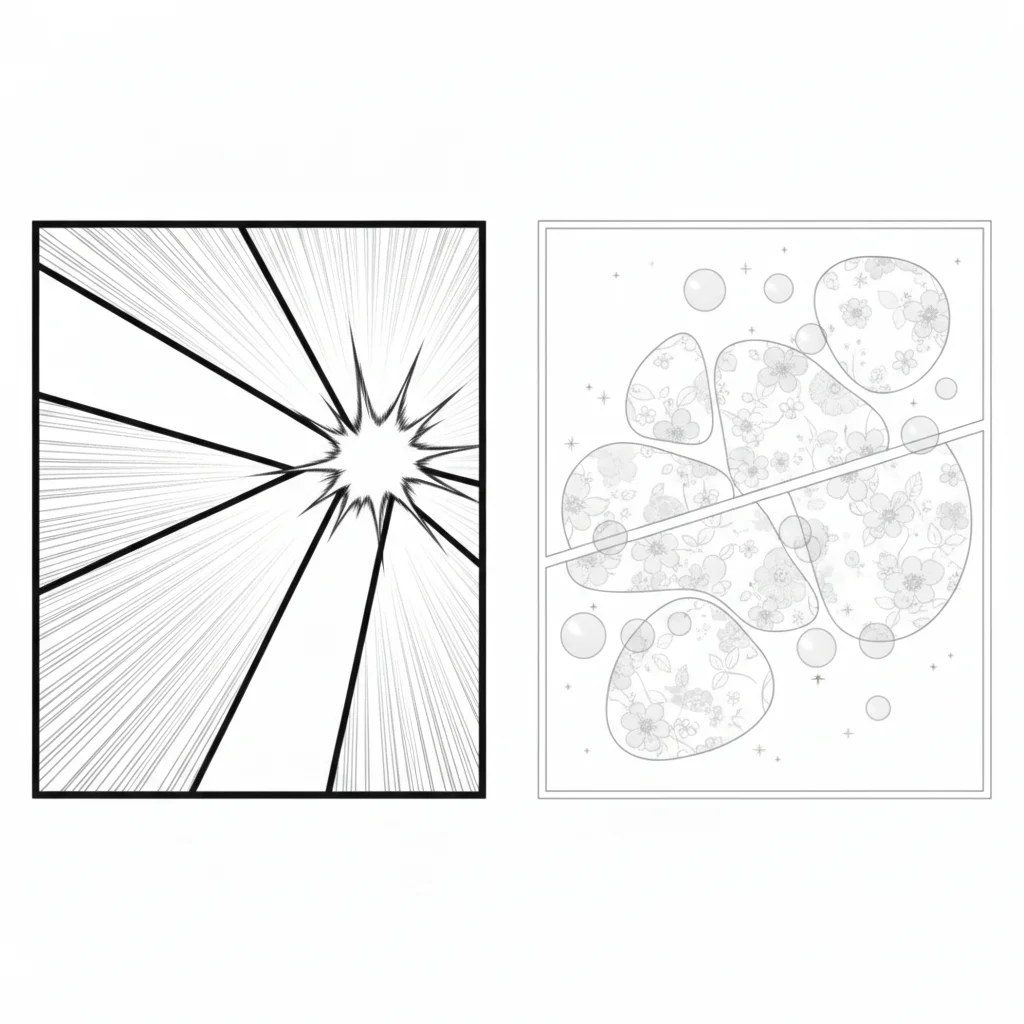
Art conventions follow the reader:
- Shonen pages are built for momentum: hard panel borders, diagonal cuts, speed lines, impact bursts and big splash panels at turning points. Reaction faces are exaggerated so a joke or a shock lands instantly.
- Shojo pages are built for feeling: panels that lose their borders, characters that break out of frames, floral and sparkle screentone behind emotional beats, and interior monologue floating free of speech bubbles. The shojo manga palette and sparkle guide breaks these devices down.
- Seinen pages are built for weight: wider establishing panels, detailed environments, heavier blacks and crosshatching, and more silence between lines of dialogue.
- Josei pages are built for observation: realistic proportions, everyday interiors drawn carefully, restrained effects, and captions that comment rather than describe.
These conventions are habits of each magazine’s house style, not requirements: seinen action series use shonen-style impact panels, and shonen romance borrows shojo screentone. The magazine, not the art, decides the label.
Which manga labels do people get wrong most often?
Five mislabels come up again and again:
- “Shonen means action.” It means a boys’ magazine. Romance, sport, cooking and horror all run in shonen.
- “Seinen means mature content.” It means an adult-men’s magazine. The gentlest slice-of-life series can be seinen.
- “Shojo means romance.” Shojo magazines run fantasy, horror, science fiction and magical-girl action too.
- Josei shelved as shojo. English shelving often sorts “girls’ manga” by gender alone, so adult-women’s series end up next to teen titles.
- Treating isekai, mecha or sports as demographics. Those are genres or settings and can sit in any of the four.
The quickest way to settle any argument: find the magazine the series was serialised in. The Wikipedia overview of shonen manga and its sister pages list magazines by demographic.
How do I pick a demographic tone for my own comic?
If you are making a comic rather than reading one, the demographic is a useful brief even though no magazine will assign it. Picking one tells you who you are writing for, which settles a dozen smaller choices at once.
- Name the reader. A 14-year-old, or a 34-year-old? That one choice sets vocabulary, how much you explain, and how much ambiguity the ending can carry.
- Choose the story engine. Goal and rivals (shonen), relationships and feelings (shojo), work and consequences (seinen), adult lives under pressure (josei), or a fun episode that resets (kodomo).
- Match the page grammar. Speed lines and impact panels for shonen; borderless panels and screentone for shojo; wide, quiet panels for seinen; restrained, observational panels for josei.
- Pick a style to match. On Comistitch, the AI manga generator style is the closest match for black-and-white shonen pacing, the romance manga style for shojo conventions, the semi-realistic comic style for a seinen register, the slice-of-life manga style for quieter josei, and the kids comic style for kodomo. Choose it from inside the builder before you generate your first page so the whole project stays in one look.
- Draft the beats first. The free manga script generator turns a premise into a scene-by-scene outline, and how to write a manga script covers structure in depth.
Here is a premise you can paste into the Studio, written with a josei brief in mind:
A 31-year-old architect in a mid-sized city is offered a promotion that would move her to another branch, three hours away, the same week her partner of six years finally proposes. Write a four-page chapter in a restrained josei tone: realistic proportions, quiet apartment and office interiors, soft grey screentone, no fantasy elements. Page one is the offer at work, page two the proposal over a late dinner, page three a sleepless night told in retrospective captions, page four an open ending at the train station at dawn.Which demographic should you write for?
- Choose shonen if your story has a clear goal and visible growth, or if you want fast, hook-driven chapters for teenage readers.
- Choose shojo if the core of your story is a relationship or a feeling, or if you want expressive, decorative layouts for teen readers.
- Choose seinen if you want room for slow pacing and unresolved moral questions, or if your conflict lives in work and institutions.
- Choose josei if your characters are adults whose relationships, careers and money pull against each other, or if you want an observational, grounded tone.
- Choose kodomo if you are writing for young children who need a complete, happy episode every time.
Not sure? Write a two-line premise and ask who would pick it up first. That reader is your target brief.
What is kodomo manga?
Kodomo (子供, “child”) is the demographic for young children, roughly under 12, and it is the one most lists leave out. Kodomo magazines such as CoroCoro Comic run short, bright, episodic stories, often connected to toys, games and anime, with simple layouts and furigana reading aids over kanji. Stories usually resolve within a chapter and the humour is broad. The Wikipedia page on kodomo manga has more on its history.
Do manhwa and webtoon platforms use demographics?
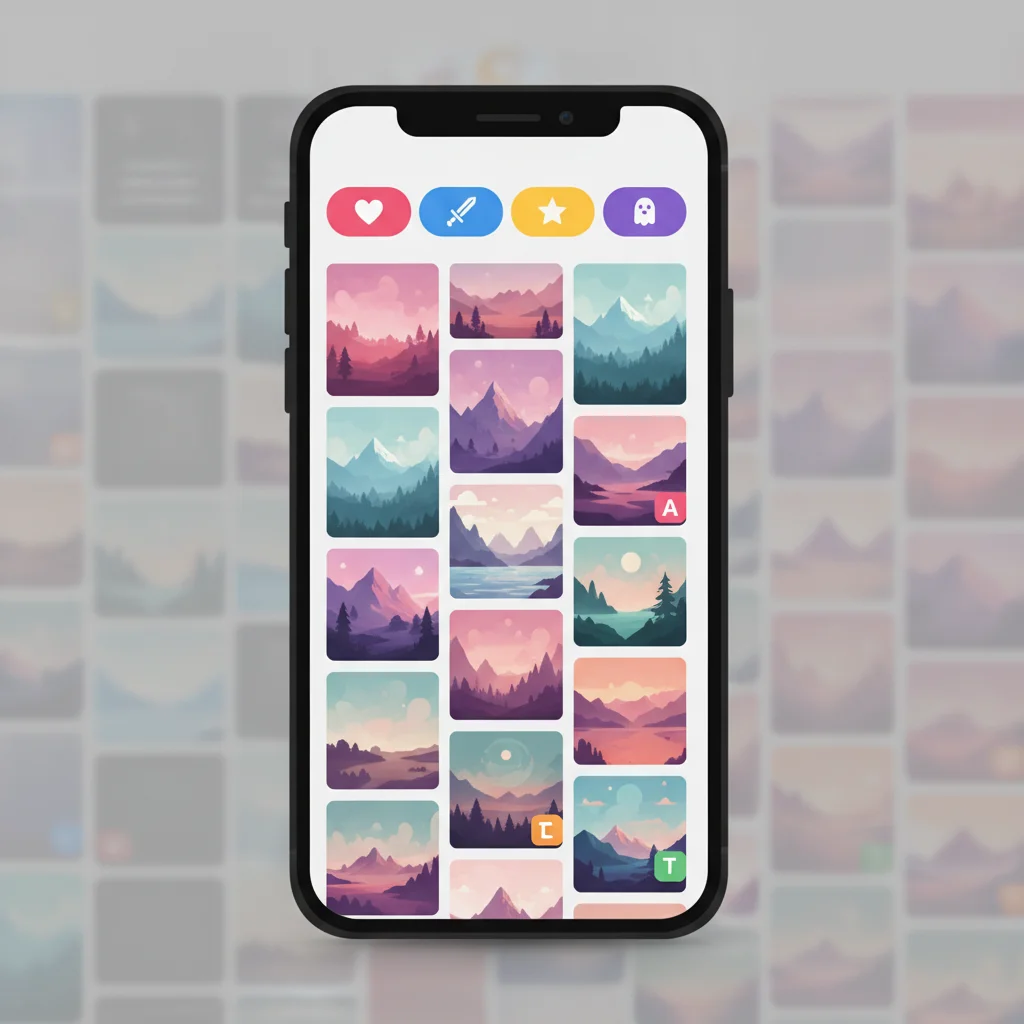
No. Korean manhwa and webtoon apps label series by genre tags — romance, action, fantasy, drama, comedy, thriller — plus a content rating, not by reader demographic. The WEBTOON and Tapas apps, for example, browse by genre. That is a consequence of the format: a vertical-scroll series is serialised inside one app that serves everyone, not inside a magazine edited for a single age and gender band. There is no shelf to inherit a label from.
Korean has its own older word for girls’ comics, sunjeong (순정) manhwa, but modern apps sort by genre rather than readership. When fans call a webtoon “shonen-like” or “josei-ish”, they are describing a tone, not a publishing category. If you want the format side of this, manhwa vs manga vs webtoon compares the three traditions directly.
Try it in Comistitch
New accounts get 100 free credits with no credit card, and a page costs 30 credits, so you can generate two or three pages in the demographic tone you chose before deciding anything. Start in the Studio, pick the style that matches your brief, and paste in the premise above or your own.
Last updated: 17 October 2026. Sources: Wikipedia entries for shonen, shojo, seinen, josei and kodomo manga — last checked October 2026.