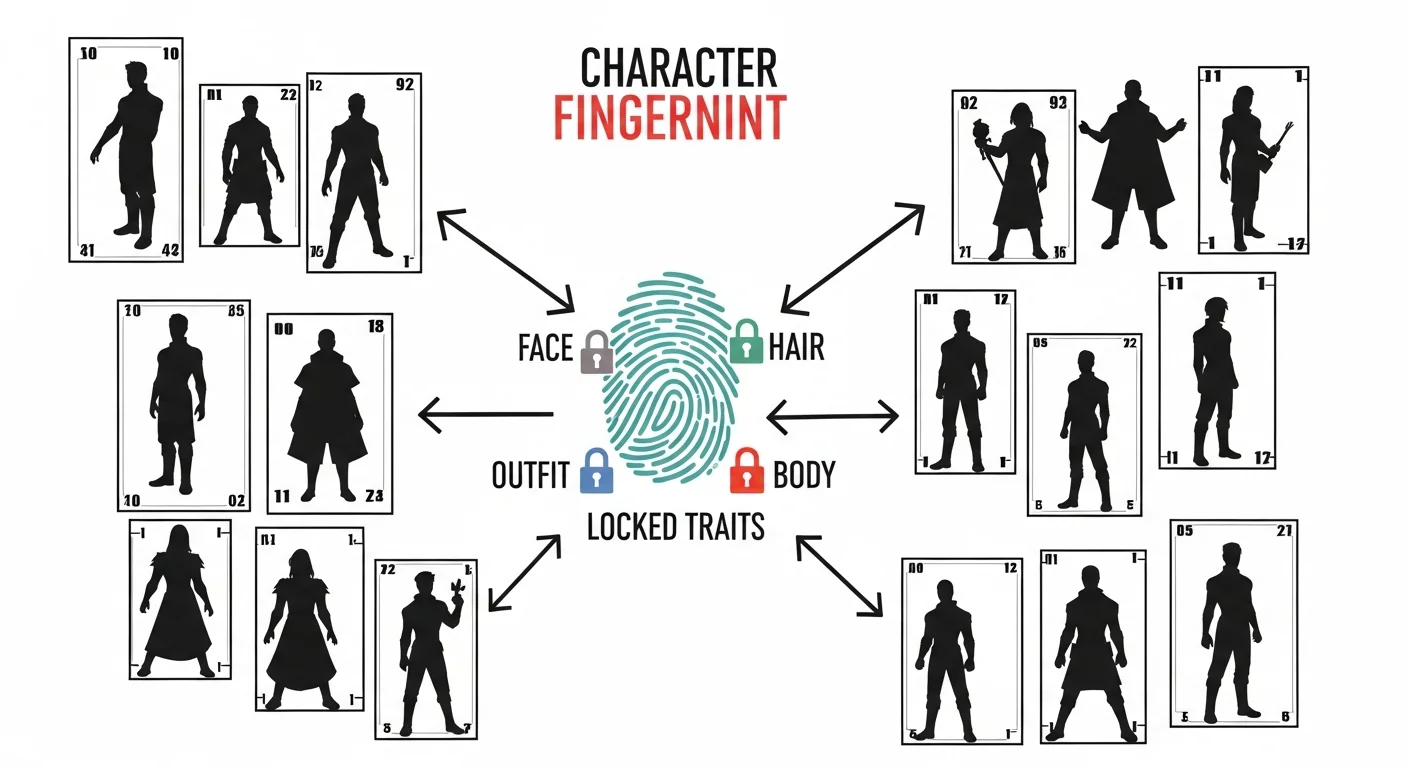
Webtoon character consistency with AI works through a “character fingerprint” — a stored signature of face landmarks, hair, outfit, and proportions that locks across every panel and chapter. Comistitch’s consistency engine references this fingerprint by character name, regenerating only pose and expression while locking the rest. 50+ chapters without drift.
In short: Save a character once. Reference by name in every panel. Comistitch locks face, hair, outfit, and proportions across 50+ chapters automatically.
What is character drift and why does it kill webtoons?
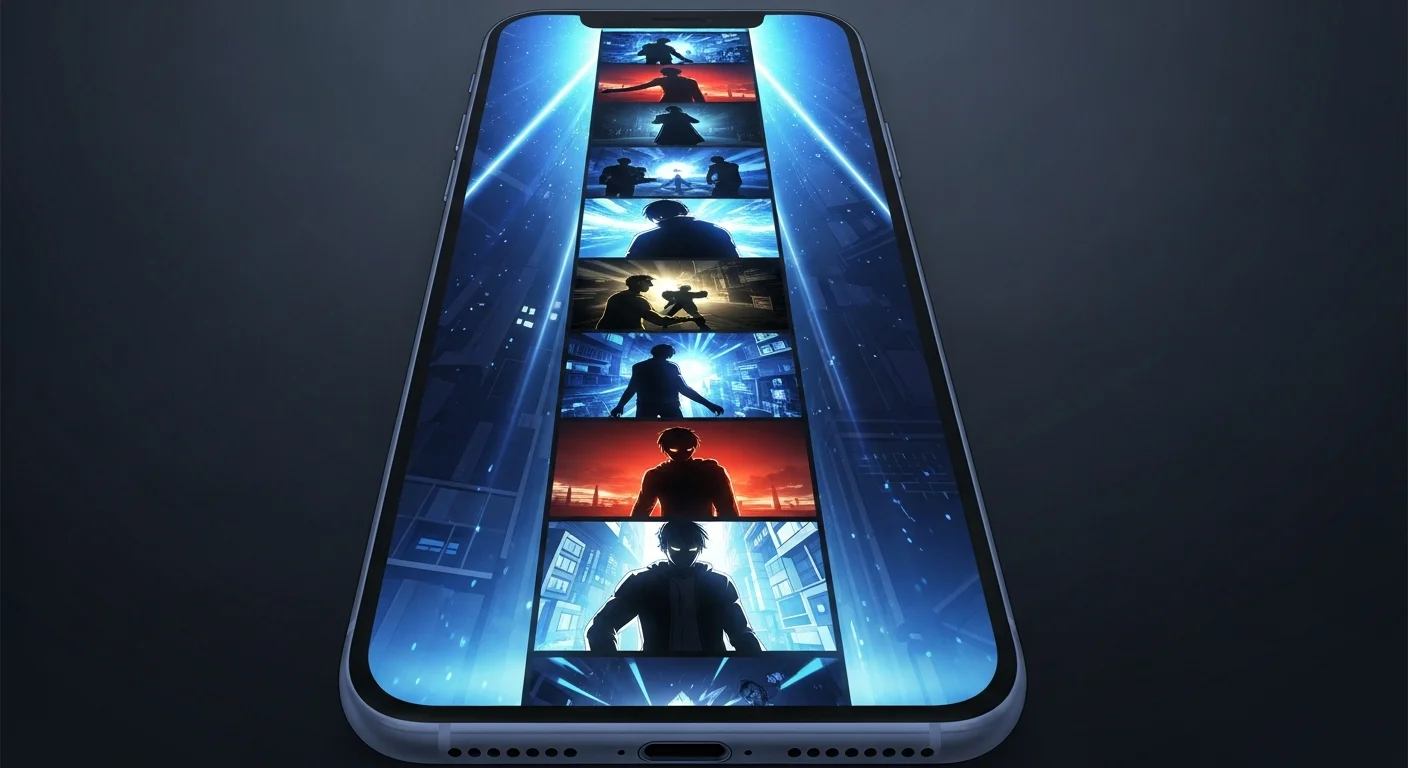
Character drift is the slow shift of a character’s appearance across panels — eye color creeping warmer, jawline sharpening, hair length wandering, outfit details mutating. It happens because most AI image tools generate each panel from scratch, anchoring only on text prompts. Two prompts that read identical to a human can produce visually different characters.
Webtoons amplify the problem. Vertical-scroll comics chain dozens of panels in a single chapter, and readers see them sequentially within seconds. The eye picks up inconsistency instantly, even when individual panels look beautiful. Retention data from creator surveys consistently shows AI webtoons losing 60-80% of readers between chapters 1 and 5 when drift is visible. Worse, the comments shift from plot discussion to “is that the same girl?” — a signal that breaks compounding word-of-mouth.
The fix isn’t better prompts — it’s structural. AI tools that rely solely on text descriptions cannot guarantee consistency across 50 panels, let alone 500. Even excellent prompts read differently to the model on each call because of seed variation, sampler entropy, and tokenization quirks. You need a system that stores the character once and references that stored signature for every panel. That’s the foundation of Comistitch’s AI webtoon creator.
How does AI lock webtoon characters?
The technique that works in 2026 is fingerprint-based locking: the AI captures a character’s distinctive features once, stores them as a structured reference, then applies that reference to every panel. Pose and expression remain free; everything else is locked.
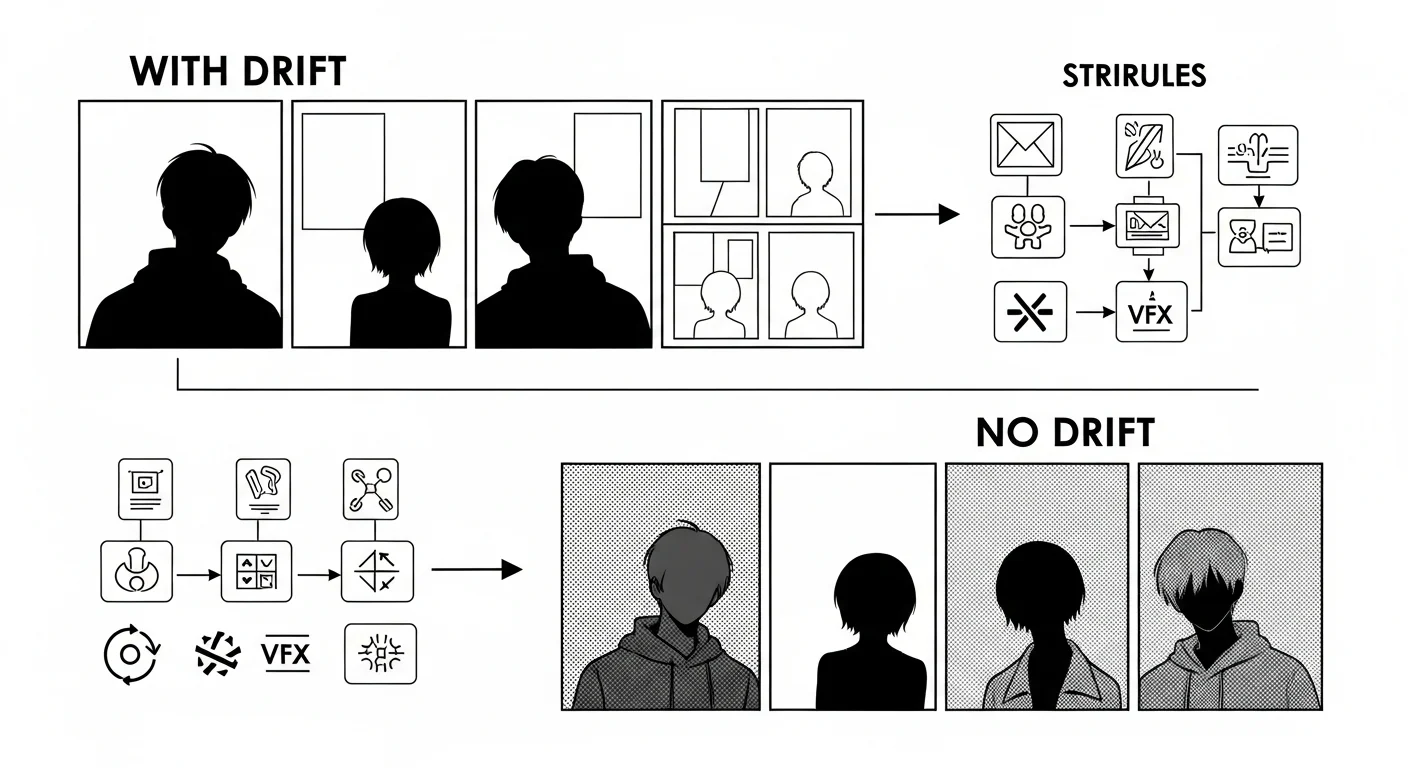
Without locking, you get the top row above — silhouettes that should match but don’t. With fingerprint locking, you get the bottom row, where every panel inherits the same proportions and outline. The builder handles this automatically: you reference the character by name in your panel script, and the engine injects the locked signature into the generation prompt before the model sees it.
This is fundamentally different from “pose reference” or “image-to-image” tricks, which still allow drift on features the reference frame doesn’t show. A reference image only constrains what’s visible in that single frame; the moment the camera angle changes, every hidden trait is back up for grabs. Fingerprint locking constrains the underlying identity, not the angle, so panels stay consistent whether the camera is overhead, behind, or in close-up.
What’s a character fingerprint?
It’s a structured record of everything that should never change. Comistitch stores roughly thirty signals per character:
- Face landmarks — eye spacing, nose bridge angle, jaw width, lip shape ratios
- Hair signature — length, parting, color hex codes, texture descriptor
- Outfit color codes — primary/secondary/accent hex values per garment
- Body proportions — height, head-to-body ratio, shoulder width
- Distinctive marks — scars, freckles, accessories, tattoos
When you generate a panel, the engine merges these signals into the prompt as locked constraints. The model is free to vary lighting, angle, mood, and pose — but it cannot deviate on locked fields. Every fingerprint is also versioned: if you tweak a hair color in week three, the previous version still lives in the library so you can roll back. For a deeper view of how this generalizes beyond webtoons, see our character consistency ultimate guide.
How does the character library work?
The library is where fingerprints live. Every project gets one, and you can build characters in two ways: trait-based (pick five attributes, the engine generates the fingerprint) or reference-based (upload images, the engine extracts the fingerprint).
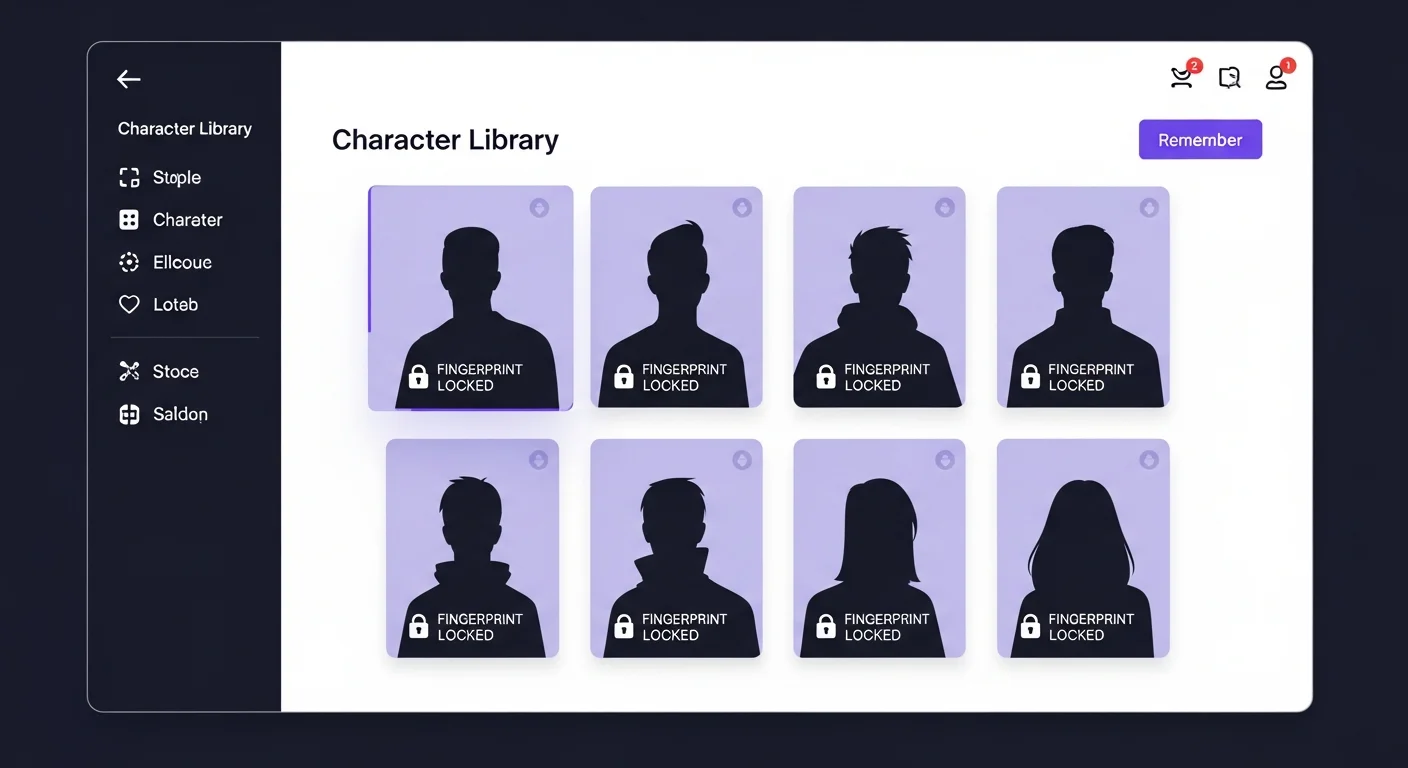
Each card in the library shows a fingerprint-locked badge once the signals are saved. From the library you can edit, duplicate, or export a character. Duplication is useful for sibling or twin designs — start from the locked fingerprint and adjust two or three signals. Export lets you carry characters between projects, which matters for series and spin-offs.
Multi-character webtoons benefit most. Reference any character by name from any panel; the engine looks up the fingerprint at generation time. There is no per-panel ceiling — group shots with five or six characters resolve each fingerprint independently and stitch them into one composition. See the full characters workspace for the live UI.
How do I verify consistency across chapters?
Locking in advance is half the work. The other half is verification — catching the rare panels where drift slipped through. Comistitch’s drift detection scans every generated panel, computes a fingerprint match score, and flags anything below the 95% threshold.
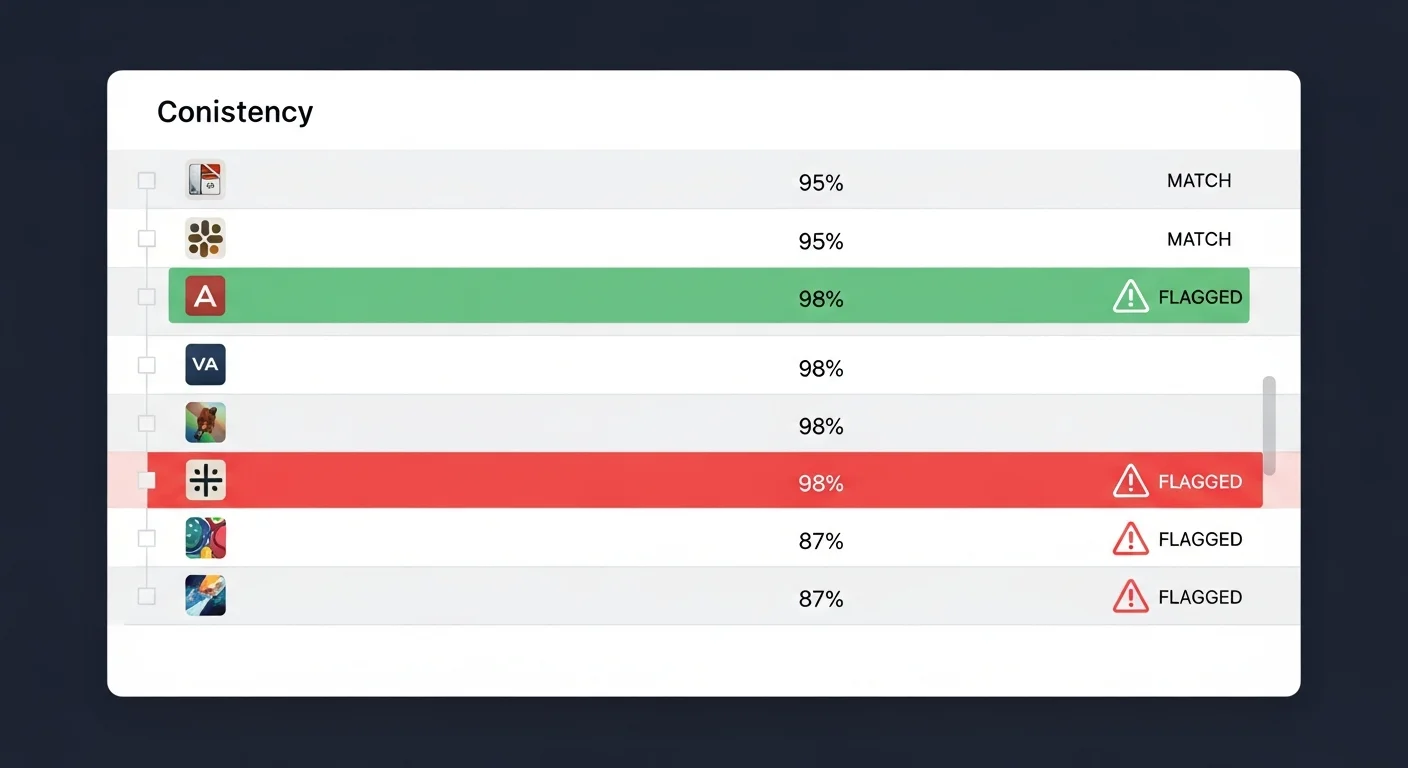
The dashboard table above shows every panel containing a given character, sorted by match score. Rows below threshold get a warning icon. One click regenerates that panel with stricter locking — usually the score climbs to 97%+ on retry. For long webtoons, scan the dashboard at the end of each chapter; it takes about two minutes for a 50-panel chapter and catches drift before readers do.
From inside the builder, you can filter the dashboard by character or chapter to isolate drift patterns quickly. The dashboard also exposes drift trends: if Chapter 12 averages 91% while earlier chapters averaged 97%, something in your prompts is fighting the fingerprint. Common culprits are over-detailed outfit descriptions or conflicting hair instructions. Strip the panel prompt back to action and emotion — the fingerprint already covers appearance — and the score usually recovers within one regenerate cycle.
The match score itself is computed across multiple feature axes — face landmark distance, hair color delta, outfit hex match, proportion ratio — and weighted so a small shift on a high-importance axis (eye spacing) costs more than a large shift on a low-importance one (background lighting on the jacket). The 95% threshold is calibrated against reader perception studies: below that, drift becomes visible to the average reader; above it, the panel reads as identical even on side-by-side compare. Batch regenerate is the heavy hammer for systemic drift — select all flagged panels in a chapter, click regenerate, and the engine re-runs each panel against the canonical fingerprint with stricter constraints. A 50-panel batch typically completes in 6-8 minutes and lifts the average score by 4-6 percentage points.
Veteran creators schedule a 10-minute consistency pass at the end of each chapter. It catches drift early, before it compounds into a chapter-wide redo, and it doubles as a quick way to spot panels where pacing or expression could be tightened.
Comparison: prompt-only vs fingerprint-based consistency
| Capability | Prompt-Only Tools | Fingerprint-Based (Comistitch) |
|---|---|---|
| Drift after 20 panels | Visible to readers | Below detection threshold |
| Multi-character support | One character at a time | Unlimited per project |
| Update mode | Manual re-prompt every panel | Forward-only or global regenerate |
| Comistitch advantage | — | Stored fingerprint + drift detection dashboard |
Prompt-only workflows can pass for short strips but break on long-form. Once you commit to a webtoon series, fingerprint-based tooling is the only sustainable path.
Try it now: lock a character in Comistitch
Open Studio, jump to the character creator, and use this template to define a fingerprint in under a minute:
Name: Maya
Gender: female
Age: 17
Build: slim, average height
Hair: shoulder-length, jet black, side-parted
Outfit: navy blazer over white tee, denim shorts
Accents: small silver hoop earrings, freckles across nose
Save, then open any panel and write Maya leans against the locker, smirking. The engine resolves the name, injects the locked signature, and generates a panel that matches every previous Maya panel in the project. Repeat for every character in your cast and you’re set up to scale to 50+ chapters — the same pacing principles from our vertical-scroll paneling pillar apply once consistency is locked.
What’s next? Polish your webtoon design
With characters locked, the next levers are visual atmosphere and reader pacing. Color carries mood across vertical scrolls — see our guide on webtoon color palette and mood design for palette systems that pair cleanly with fingerprint-locked characters. Then layer in beat structure with webtoon pacing and cliffhanger techniques so each chapter ends with a hook.
Ready to ship? Open Comistitch Studio, build your first locked character, and start your webtoon today. Drift-free chapters, multi-character casts, and verified consistency are all part of the default workflow — no plugin, no add-on, no manual checks.