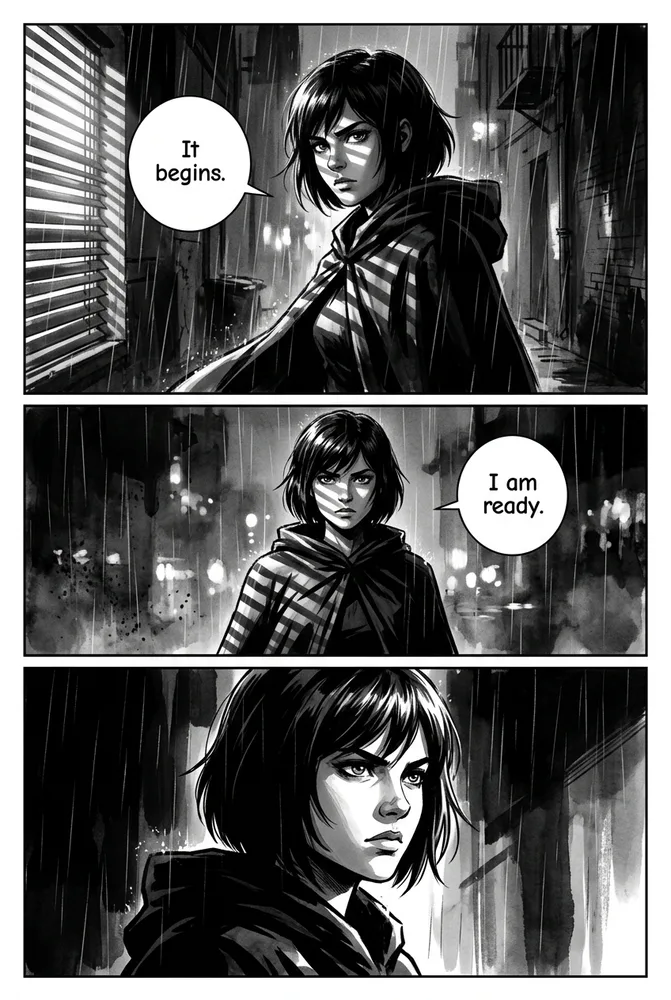
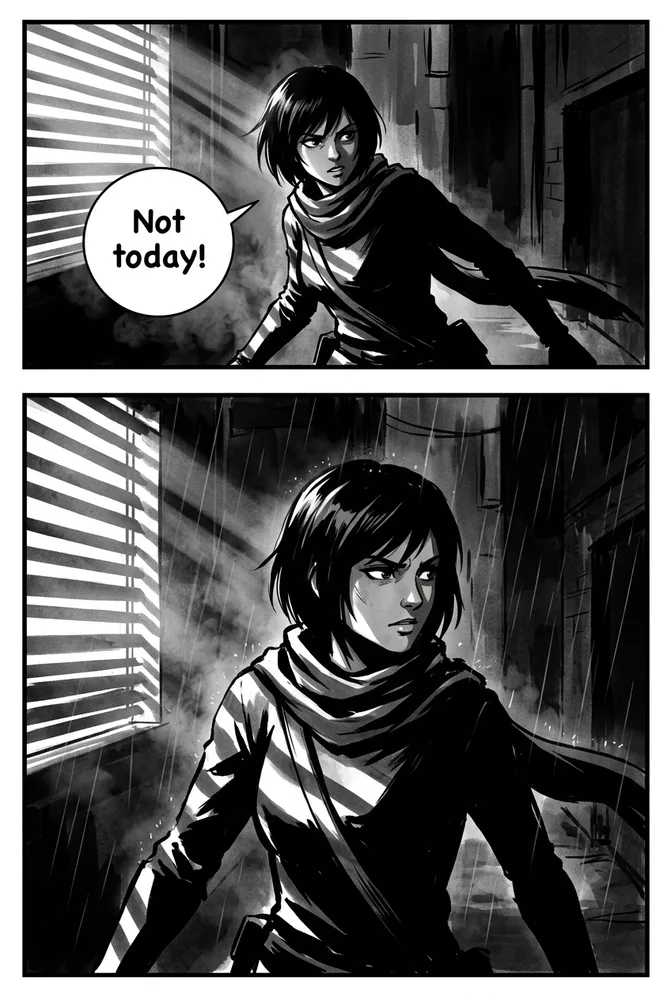
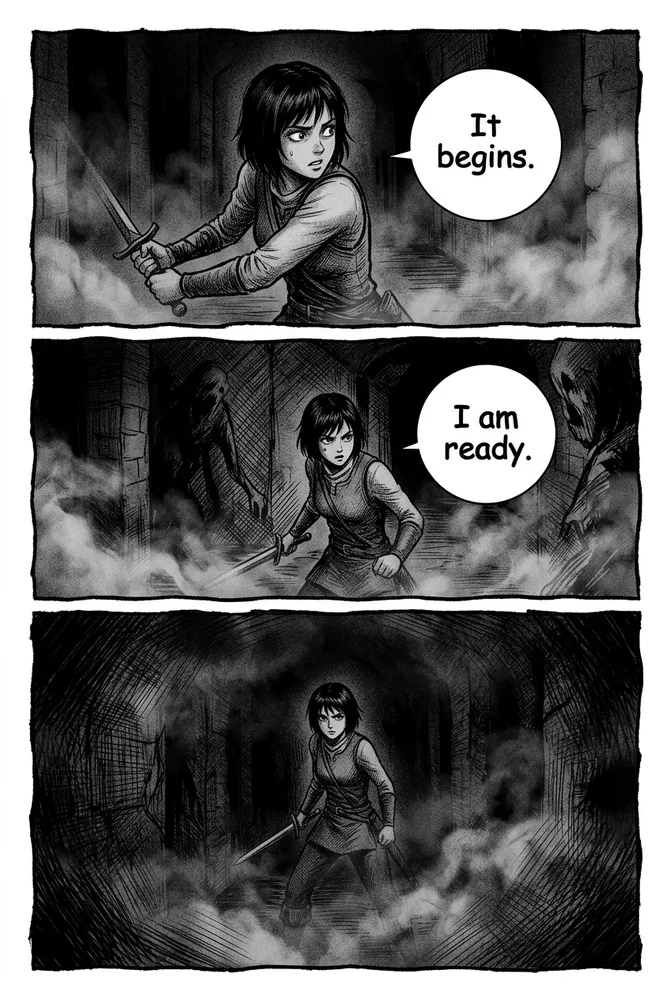
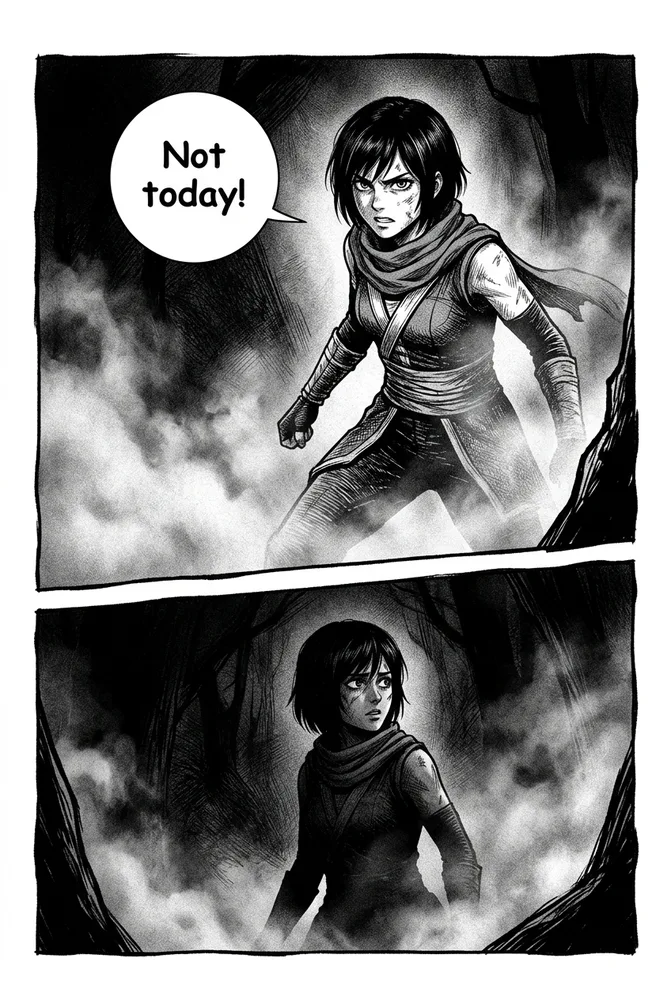
AI dark comic styles fall into two distinct moods: noir-detective (hard-edged black-and-white shadow, crime plots, caption narration) and horror (atmospheric fog, cross-hatch dread, obscured threats). Both rely on lighting and restraint rather than color or gore — get the shadow language right in your prompt and the mood follows automatically. Both sections below also carry the same fictional cast into an action scene, so you can confirm the character stays consistent as the mood shifts.
In short: Noir style is built from hard chiaroscuro lighting and detective convention; horror style is built from atmospheric fog and cross-hatch dread. Name the lighting, palette, and what’s hidden in your prompt — that’s the entire cheatsheet.
This guide is one piece of the broader AI comic art styles comparison — start there for all 20 styles side-by-side, or keep reading for the noir and horror prompt recipes specifically.
What Makes a Comic Style “Dark” in AI Generation?
“Dark” in comic art isn’t a color palette setting — it’s a lighting and information-control decision. A dark comic style deliberately withholds visual information: deep black shadow zones the eye can’t fully read, fog or smoke that partially obscures a threat, and high-contrast lighting that turns ordinary compositions tense. Bright, evenly lit panels feel safe by default; dark comic styles engineer discomfort through what the reader can’t see as much as what they can.
Two product styles anchor this category from inside the builder: noir-detective and horror. They share a family resemblance — both lean on shadow, both reward restraint over spectacle — but they solve different storytelling problems. Noir is a genre convention with fixed visual rules. Horror is a mood that adapts its visual language to whatever specific dread the story needs.
How Do I Prompt the Noir-Detective Comic Style?
Noir-detective style is built on hard, high-contrast black-and-white lighting: deep blacks, minimal midtones, and spotlight-style illumination that carves a scene into light and shadow rather than gradients. Classic visual cues — venetian-blind light bars across a face, rain-slicked streets reflecting neon, smoke curling under a desk lamp — all reinforce the same lighting logic.
- Lock the lighting first. “Hard chiaroscuro lighting, venetian-blind shadow bars, high-contrast black and white” — this single phrase does most of the work before you describe anything else.
- Set the scene convention. Rain-slicked alleys, interrogation rooms, fire escapes, and fedora silhouettes are genre shorthand the model recognizes instantly.
- Specify caption-box narration. Noir comics run on first-person voiceover captions layered over the art — mention this explicitly if you want that hardboiled internal-monologue framing.
- Choose an era. “Mid-century urban” reads classic detective pulp; “modern neo-noir” keeps the same shadow rules in a contemporary setting.
Generate a noir-detective comic panel: rain-slicked city alley at night, a lone figure in a trench coat and fedora silhouetted against a flickering neon sign, hard chiaroscuro lighting with venetian-blind shadow bars crossing the scene, deep black shadow zones, minimal midtones, high-contrast black and white rendering. Add a caption box at the bottom in first-person hardboiled narration style. Maintain consistent shadow direction and character silhouette across the page.Want the full workflow instead of a single prompt? The noir detective AI comic build diary walks through concept, world, scripting, and publishing a complete noir project start to finish.
How Do I Prompt the Horror Comic Style?
Horror style trades noir’s fixed lighting rules for something more adaptive: atmospheric shadow and fog that create unease through visual ambiguity. The reader should never fully see the threat — partial obscurement, cross-hatch texture, and geometric wrongness in the composition do more work than an explicit, fully-rendered monster ever could.
- Lead with atmosphere, not the threat. “Grainy heavy ink, environmental fog, cross-hatch shadow texture” sets the mood before anything scary even enters frame.
- Obscure deliberately. Describe the creature or threat as “partially visible,” “glimpsed at the edge of frame,” or “obscured by fog” rather than fully detailed — restraint reads scarier than explicit gore.
- Use claustrophobic framing. Tight panel crops, distorted perspective, and geometric asymmetry signal wrongness before the reader consciously registers why.
- Pace the reveal. Horror works in sequence — a slow-burn run of quiet panels followed by a single sharp reveal panel builds dread far more effectively than constant intensity.
Generate a horror comic panel: dim fog-filled corridor, a figure's silhouette partially obscured by drifting mist at the far end of the frame, grainy heavy ink texture, dense cross-hatch shadow in the corners, claustrophobic tight framing with a slightly tilted camera angle. Keep the threat mostly hidden — suggest wrongness through posture and shadow rather than explicit detail. Environmental fog and negative space should carry the dread.For a full black-ink, negative-space treatment of psychological horror, see horror manga with AI — black ink dread, which goes deeper into the specific technique of building tension through what’s left unsaid.
Noir vs Horror: Which Dark Style Fits Your Story?
| Aspect | Noir-Detective | Horror |
|---|---|---|
| Look | Heavy chiaroscuro ink, hard black-and-white | Grainy ink, environmental fog, cross-hatch |
| Lighting | Hard-edged spotlight, venetian-blind bars | Diffuse, obscuring, low-visibility |
| Palette | Mostly black and white | Muted color or B&W, desaturated |
| Best for | Crime plots, detective narration, mystery | Supernatural threats, psychological dread |
| Comistitch advantage | Caption-heavy panel layouts built in, from inside the builder | Slow-burn pacing tools for the reveal sequence |
Can I Combine Noir and Horror in One Comic?
Yes — noir-horror hybrids are a well-established genre, from supernatural-detective mysteries to cosmic-horror crime plots. The two styles share enough visual DNA (shadow, restraint, high contrast) that combining them is closer to blending than clashing. Layer noir’s hard lighting language — venetian-blind shadow, spotlight illumination — with horror’s atmospheric cues — fog, cross-hatch, partial obscurement — in the same scene description, and the model reads both as compatible instructions rather than conflicting ones. A detective walking into a fog-choked alley where something isn’t quite right is a completely valid single-panel prompt.
What Mistakes Do Creators Make With Dark Comic Styles?
- Over-describing the horror threat. Full, explicit creature descriptions kill the ambiguity that makes horror unsettling. Describe what’s implied, not what’s fully visible.
- Skipping the lighting keyword for noir. “A detective in an alley” alone won’t produce the noir look — you need the explicit chiaroscuro/high-contrast lighting instruction every time.
- Flattening the whole page to one intensity. Both styles rely on pacing — a page of constant maximum shadow or constant maximum dread reads as visual noise rather than tension. Vary panel intensity to build toward a payoff panel.
- Confusing “dark” with “gory.” Neither noir nor horror style requires graphic content. The mood comes from lighting and implication, not explicit violence.
Does Style Choice Depend on Story Genre?
Loosely, yes, though the two styles aren’t locked to a single genre. Noir pairs naturally with detective, crime, and mystery plots — its caption-narration convention practically assumes a hardboiled investigator voice. Horror is more flexible: it suits supernatural fiction most directly, but psychological thrillers, slow-burn survival stories, and even quiet character dramas can borrow horror’s shadow-and-fog toolkit for a single tense sequence without committing the whole comic to the genre. Neither style is exclusive — a mostly-lighthearted story can use one horror-style page for a nightmare sequence just as easily as a dedicated horror comic can.
How Do I Keep a Dark Comic Style Consistent Across a Full Page?
Lock your lighting and palette keywords at the page level rather than re-describing them panel by panel — repeat the core phrase (“hard chiaroscuro lighting” or “environmental fog and cross-hatch”) in every panel prompt within the same page, and let panel-to-panel variation come from framing and pacing instead. Comistitch’s character consistency engine handles the character design side of this automatically: once a character reference is locked, you can vary shadow intensity for dramatic pacing without the character drifting between panels. Shipped from the panel canvas, a full noir or horror page usually needs only 2-3 lighting-keyword tweaks to carry consistent mood start to finish.
Try It: Comistitch Prompt Example
Paste this into Comistitch Studio to compare both dark styles from a single base scene:
Panel 1 (noir-detective style): A detective standing in a rain-slicked alley, hard chiaroscuro lighting, venetian-blind shadow bars crossing their face, deep black shadow zones, high-contrast black and white, caption box: "The city doesn't keep secrets. It just charges rent for them."

Panel 2 (horror style): The same alley, moments later, thick fog rolling in, a barely-visible silhouette at the far end partially obscured by mist, grainy heavy ink, dense cross-hatch shadow in the corners, claustrophobic tilted framing, no dialogue — just dread.
Running the same base scene through both styles is the fastest way to feel the difference between noir’s fixed hard-light rules and horror’s more adaptive atmospheric dread.
Where to Next?
- AI comic art styles compared — see all 20 product styles side-by-side on the same character
- Noir detective AI comic build diary — a full 5-part project from concept to publishing
- Horror manga with AI — black ink dread — a deep dive on psychological horror technique
- Noir comic style page — generate a noir sample panel
- Horror comic style page — generate a horror sample panel
Ship your first dark-mood comic page in minutes. Start free at Comistitch — the builder handles shadow, fog, and lighting consistency for whichever dark style you name.