Updated May 2026 — A working pipeline for sci-fi graphic novel character study pages with painted realism, generated end-to-end with AI in about 22 minutes per page.
The hardest sci-fi to write is not the space opera with explosions every page. It’s the quiet character study where a person navigates a dystopia panel by panel — the worldbuilding has to do real work, the protagonist arc has to land, and the rendering has to carry literary weight. The sci-fi graphic novel AI dystopian character study workflow in Comistitch — using Hyperreal Painted or Graphic Novel Painted — handles the rendering so you can focus on the arc.
The short answer: dystopian character study sci-fi needs painted realism, environment-as-character worldbuilding, and a protagonist bible the dystopia has physically marked. AI generators with painted sci-fi stacks (Comistitch Pro and Elite) produce this register in 3-5 minutes per page versus 15-50 hours hand-painted.
TL;DR
- Dystopian character study = interior arc + worldbuilding as pressure, not backdrop
- Painted realism gives sci-fi the literary weight prestige work needs
- Environment cues in every scene script — surveillance, scarcity, decay markers
- Protagonist bible includes one world-marked anatomy detail
- Comistitch Hyperreal Painted (Elite) for standalone, Graphic Novel Painted (Pro) for serial
- 22 minutes per page end-to-end, MoR-safe, commercial rights included
What Is a Dystopian Character Study in Graphic Novel Form?
A dystopian character study is a specific sci-fi sub-genre that swaps spectacle for interior arc. Where space opera asks “what happens next,” character study asks “what does this place do to this person.” The format traces a lineage from V for Vendetta (Moore/Lloyd, 1988) through Y The Last Man’s quieter chapters (Vaughan/Guerra, 2002-2008), Saga’s intimate beats (Vaughan/Staples, 2012-present), and contemporary prestige work like Far Sector (Jemisin/Campbell, 2019).
The defining structural features:
- The dystopia is a pressure test. Surveillance, scarcity, ideological collision, ecological collapse — the world exerts force on the protagonist, and the arc tracks how that force deforms them.
- The protagonist is interior. Their journey is moral, not just physical. They compromise, fail, recover, compromise again.
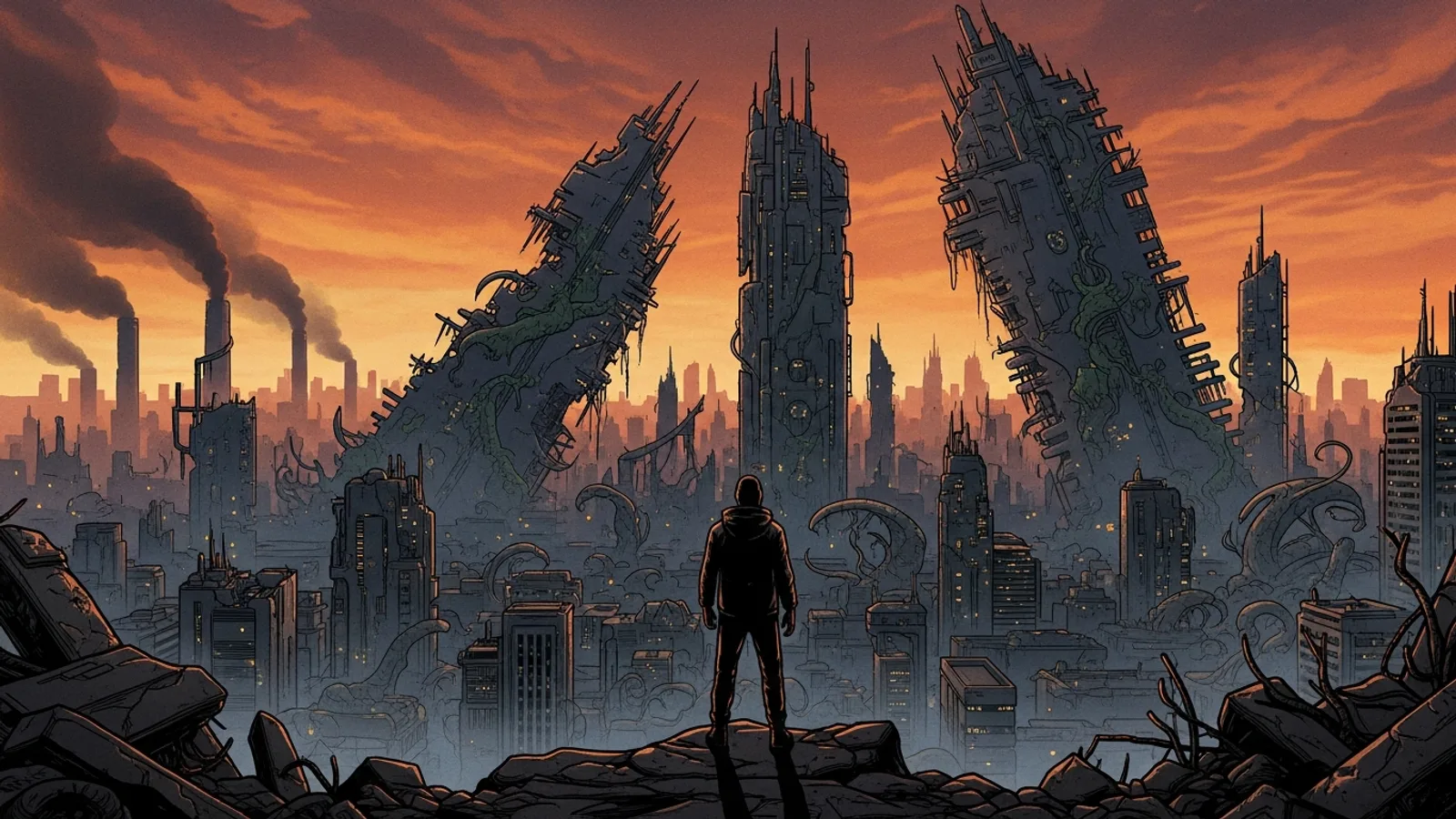
- The worldbuilding is character. Buildings, light, weather, signage, body-language conventions all carry information about the regime or condition.
- The reading pace is slow. Panels breathe. Splash pages do real narrative work. Action sequences are rare and weighty when they happen.
Per the Graphic Novel Reporter’s 2024 prestige sales index, painted sci-fi character study graphic novels outsell flat-color sci-fi adventure 1.8:1 in the literary trade segment, despite lower total volume.
In short: dystopian character study = interior arc tested by world-as-pressure. Slow pace, painted weight, every panel earns its space.
Why Does Painted Realism Suit Dystopian Sci-Fi Better Than Flat Color?
Visual register signals genre intent. Flat-color sci-fi reads as adventure or YA. Painted realism reads as literary. The difference is not snobbery — it is communication. Readers picking up a painted sci-fi page expect a different reading contract than readers picking up a flat-color sci-fi page.
Painted realism in dystopian sci-fi does three specific jobs:
- Surface weight. Concrete reads as cold. Cloth reads as worn. Metal reads as oxidized. The dystopia feels lived-in instead of decorative.
- Atmospheric depth. Smog, ash fall, weak filtered daylight, recycled air — painted rendering carries these as visual texture, not just descriptive caption.
- Anatomy gravity. Worn protagonists look worn. Stress, fatigue, and ideological erosion show up in faces and posture. Flat-color faces can’t carry that information.
For full painted-style comparison and how dystopian sci-fi maps to each Comistitch realistic preset, see the AI realistic comic generator pillar.
In short: painted realism = surface weight + atmospheric depth + anatomy gravity. All three are non-optional for literary sci-fi.
How Do Painted Sci-Fi Styles Compare for Character Study Work?
The honest comparison for dystopian character study sci-fi:
| Dimension | Hyperreal Painted | Graphic Novel Painted | Storybook Oil Painting | Semi-Realistic Comic |
|---|---|---|---|---|
| Tier | Elite | Pro | Pro | Starter |
| Best for | Prestige one-shot | Serialized arc | Soft / hopeful dystopia | Adventure-leaning sci-fi |
| Worldbuilding density | Very high | High | Medium | Low |
| Anatomy gravity | Maximum | High | Medium | Low |
| Reading pace match | Slow contemplative | Slow contemplative | Quiet, intimate | Fast, energetic |
| Render time per panel | 30-50 sec | 25-40 sec | 20-35 sec | 15-25 sec |
The general rule: Hyperreal Painted for one-shot prestige sci-fi (think a 100-page hardcover); Graphic Novel Painted for monthly serial sci-fi where you need throughput plus weight; Storybook Oil Painting for softer dystopias with hope (think The Giver visual register); Semi-Realistic for sci-fi adventure where speed matters more than gravity.
The related cinematic photoreal noir guide covers a different sibling register that shares lighting discipline with dystopian sci-fi — worth reading if your dystopia leans noir.
In short: Hyperreal for one-shot, Graphic Novel Painted for serial, Storybook for soft dystopia, Semi-Realistic for adventure-leaning sci-fi.
How Do I Build a Dystopian Character Study Page Step by Step?
The workflow below is what Comistitch beta testers used to ship a 120-page dystopian sci-fi graphic novel during Q1 2026. Six steps per page, roughly 22 minutes start to finish.
Step 1. Define the world’s pressure point before writing any panel
Before any visual work, name the dystopia’s core compromise in one sentence:
- “Citizens trade biometric data for ration credits.”
- “The atmosphere requires daily medication to breathe; medication is gated by political compliance.”
- “Memory of pre-collapse history is illegal.”
Every scene in your graphic novel should pressure-test the protagonist against this compromise. If a scene doesn’t, cut or rewrite it.
Step 2. Lock style and protagonist bible
In Studio, create a new project and select Hyperreal Painted (Elite) for standalone prestige or Graphic Novel Painted (Pro) for serialization.
Dystopian protagonist bible template:
- Build and posture (often “shoulders rounded from work or surveillance pressure”)
- One world-marked anatomy detail (“chemical burn scar on right cheek, faded but visible,” “missing ring finger from industrial accident,” “prematurely greying hair from environmental stress”)
- Wardrobe signature (“layered grey work clothes, repaired with mismatched patches, government-issued ID badge clipped at collar”)
- Signature item (“worn paper notebook, contraband”)
The world-marked anatomy detail is the critical addition for dystopian sci-fi. The body is a record of the dystopia.
Step 3. Draft scenes with environment-as-character cues
A dystopian character study scene that works:
“Interior, communal mess hall, early morning. Bleached fluorescent ceiling lights, dead grey. Surveillance camera in upper corner. Long metal benches. Ration ticket dispenser at far end. Protagonist sits alone, head down, working a tin spoon through grey-brown protein paste. Other workers visible at distant tables, silent.”
Note the worldbuilding work: lighting type names the regime’s neglect, the camera names surveillance, the dispenser names scarcity, the silence names compliance. The protagonist is barely described because the world is doing the characterization.
Step 4. Generate and audit worldbuilding coherence
Run the page. Beyond standard QA, audit specifically for:
- Architectural signature continuity. The same brutalist concrete or copper-patina cladding across the chapter.
- Atmospheric continuity. The same haze, the same ash fall, the same filtered daylight.
- Surveillance signature. Cameras, drones, ID checkpoints styled consistently.
- Wardrobe signature for background figures. Other workers should be styled as plausibly belonging to the same regime.
Per Comistitch internal QA from Q1 2026, dystopian sci-fi pages have a 16-24% panel re-roll rate, slightly higher than other painted styles because worldbuilding continuity adds an extra failure axis. Budget 6-8 minutes per page for QA.
Step 5. Compose dialogue with regime-coded language
Dystopian dialogue carries world signal. Forms of address, oblique references to “the program” or “the commission,” euphemisms for violence — these are characterization. Keep dialogue sparse; the painted art carries weight that prose dialogue would over-explain.
Step 6. Export at literary page sizing
Painted dystopian sci-fi reads at print sizes. Export 300dpi for hardcover trade paperback or prestige hardcover. For digital, use a slow-scroll page-by-page presentation rather than fast webtoon vertical — the contemplative pace requires reader patience and the format should support it.
In short: define pressure point → style + bible with world-marked anatomy → environment-cue scripts → generate → worldbuilding audit → coded dialogue → literary sizing. ~22 min per page.
What Are the Common Failure Modes in AI Dystopian Sci-Fi?
Four failure modes account for most re-rolls:
The “generic sci-fi” failure. The model produces a competent-looking sci-fi image with no specific dystopian signal. Fix: re-state the regime’s visual signature in the prompt (“brutalist megastructure with copper-patina vertical bio-vents,” not “futuristic building”).
The “too clean” failure. Dystopian environments default to clean futuristic styling unless you fight against it. Fix: add explicit decay descriptors (“water-stained walls, peeling propaganda posters, rust-streaked metal panels, ash dust on horizontal surfaces”).
The character-vanishes-in-worldbuilding failure. The environment is so dense the protagonist becomes a small figure. Fix: stage the protagonist in foreground or midground with a strong rim light catching them, and re-state the wardrobe silhouette in every scene.
The drift across chapters failure. By chapter 4, the megastructures have shifted style and the protagonist has subtly changed. Fix: pre-generate 8-12 establishing shots of major locations at project start and refer to them in every scene set there. The full method for character drift is in the AI comic character consistency guide.
In short: generic sci-fi, too clean, character lost in world, cross-chapter drift. Prevent with specific worldbuilding vocabulary, decay descriptors, rim lighting, and establishing-shot reference library.
Frequently Asked Questions
What is a dystopian character study in graphic novel form? Interior arc + worldbuilding as pressure. See What Is a Dystopian Character Study above.
Why painted realism over flat color? Surface weight, atmospheric depth, anatomy gravity. See Why Does Painted Realism Suit Dystopian Sci-Fi.
Which plan handles dystopian sci-fi? Hyperreal Painted (Elite) for standalone, Graphic Novel Painted (Pro) for serial.
Can AI handle alien architecture and worldbuilding? Yes, with specific prompt vocabulary. Generic prompts produce generic output. See the pillar comparison for the full painted-style overview.
How do I keep a sci-fi protagonist consistent? Locked style seed + re-stated silhouette per scene + establishing shots of locations. See the character consistency guide.
Start a Dystopian Sci-Fi Project
If you’re building a prestige sci-fi graphic novel where the world tests the protagonist panel by panel, painted realism is your register. Open Comistitch Studio → and select Hyperreal Painted or Graphic Novel Painted to start.
Related Reading
- AI Realistic Comic Generator 2026 — pillar comparison of painted styles
- Cinematic Photoreal Noir AI Comic — sibling realistic style with shared lighting discipline
- AI Comic Character Consistency Guide — prevent drift in long-form sci-fi
- AI Sci-Fi Dystopian Webtoon Showcase — the vertical-scroll take on this world