Updated May 2026 — A working pipeline for painted western frontier comic pages, generated end-to-end with AI in roughly 16 minutes per page.
Western is a visual genre. Wide skies, weathered faces, dust on boots, a single figure walking a long road at golden hour — the imagery does as much narrative work as the dialogue, sometimes more. Reproducing that imagery by hand demands landscape painting fundamentals and the patience to render dust haze and heat shimmer. The western frontier realistic comic AI workflow in Comistitch — using Graphic Novel Painted on Pro tier — collapses that learning curve while keeping the painted weight intact.
The short answer: western frontier realistic comics need painted texture, dusty desaturated palette, wide-frame landscape composition, and weathered anatomy. AI generators with painted-style stacks (Comistitch Graphic Novel Painted) reproduce this register in 2-4 minutes per page where hand-painted western pages take 10-30 hours.
TL;DR
- Western frontier realism = painted texture + dusty palette + wide landscape + weathered anatomy
- Landscape-first scene construction — the world before the character
- Comistitch Graphic Novel Painted (Pro) is the default; Semi-Realistic for action, Hyperreal for prestige
- Atmospheric specifics (dust haze, golden hour rake, heat shimmer) must be named in every prompt
- Sparse dialogue + visual breathing room = western page rhythm
- 16 minutes per page end-to-end, MoR-safe, commercial rights included
What Defines the Western Frontier Realistic Comic Register?
Western frontier realism is a specific visual register with consistent rules. The lineage runs from Frederic Remington’s late-19th-century frontier paintings through Sergio Leone’s spaghetti western framing (1964-1968), Frank Frazetta’s painted western covers, Clint Eastwood’s late films like Unforgiven, and graphic novels from Jonah Hex through Jeff Lemire’s Sweet Tooth western beats. The defining features:
- Wide landscape composition. The figure is often small in the frame. The landscape carries narrative weight.
- Dusty desaturated palette. Ochre, burnt sienna, washed blue, faded denim, bone-white. Saturation is low; values do the work.
- Weathered anatomy. Sun-burnt skin, squint lines, sweat stains, dirt on cloth. Faces have lived hard.
- High-contrast lighting. Golden-hour raking light or harsh midday top-down — never flat illumination.
- Atmospheric texture. Dust haze, heat shimmer, low backlit silhouettes. The air is always doing something.
Per the Graphic Novel Reporter’s 2024 western sub-genre review, painted western graphic novels — even at lower production volume than other realistic genres — show retention rates 1.6x higher among returning prestige-segment buyers compared to flat-stylized western adventure work.
In short: wide landscape + dusty palette + weathered anatomy + high-contrast light + atmospheric texture. All five together signal western. Miss one and the register slips.
How Does AI Render Painted Western That Holds Up?
Generic AI western prompts produce sci-fi-looking output — flat horizons, clean clothes, midday illumination. The painted western register requires four prompt anchors, every scene:
- Named landscape feature. “Mesa with horizontal sandstone striations” not “rocks.” “Salt flat extending to vanishing point” not “flat ground.” “Canyon floor with scree slopes” not “valley.”
- Atmospheric specifics. Dust haze, heat shimmer, low golden rake, midday sun glare. Name the air’s behavior.
- Wardrobe and gear specifics. Duster coat, sweat-stained shirt, hat brim shadow profile, scuffed boots, holster wear pattern. Western costumes are not “western clothes.”
- Posture and weathering vocabulary. “Sun-burnt skin,” “squint lines around eyes,” “shoulders rounded from long ride,” “dust on coat.” Anatomy descriptors that read as lived experience.
Comistitch’s Graphic Novel Painted style interprets these anchors with painted gouache fidelity — the rendering engine actually produces dust haze and rake lighting, not vague atmospheric soup. The same prompt feed to a flat manga style produces a totally different output, which is why style selection is upstream of prompt vocabulary.
In short: named landscape + named atmosphere + named wardrobe + weathered vocabulary. Every prompt, every scene.
How Do Painted Styles Compare for Western Work?
The honest comparison for western frontier graphic novels:
| Dimension | Graphic Novel Painted | Semi-Realistic Comic | Hyperreal Painted | Storybook Oil Painting |
|---|---|---|---|---|
| Tier | Pro | Starter | Elite | Pro |
| Best western fit | Serialized frontier drama | Western action / adventure | Prestige standalone | Romantic / quieter western |
| Landscape rendering | Painted gouache | Bold ink + paint | Photoreal cinematic | Soft luminous |
| Atmospheric fidelity | High | Medium | Very high | Medium-soft |
| Reading pace | Slow contemplative | Fast energetic | Slow contemplative | Slow, warm |
| Render time per panel | 25-40 sec | 15-25 sec | 30-50 sec | 20-35 sec |
The general rule: Graphic Novel Painted for the canonical painted-western register (think Lemire’s western beats, Frazetta’s painted covers); Semi-Realistic for western action where pace matters; Hyperreal for prestige one-shot work; Storybook for soft western romance or coming-of-age frontier stories.
For the full pillar comparison of all four realistic styles, see the AI realistic comic generator guide. For an adjacent painted-genre walkthrough, the Alex Ross painted realism guide covers shared techniques that apply directly to painted western work.
In short: Graphic Novel Painted is the default. Semi-Realistic for action. Hyperreal for prestige. Storybook for soft western.
How Do I Build a Western Frontier Page Step by Step?
The workflow below is what Comistitch beta testers used to ship an 80-page western frontier graphic novel during Q1 2026. Five steps per page, roughly 16 minutes start to finish.
Step 1. Lock style and protagonist bible
In Studio, create a new project and select Graphic Novel Painted.
Western frontier protagonist bible template:
- Build and posture (“medium height, shoulders rounded from long ride, slow deliberate walking pace”)
- Weathered anatomy (“sun-burnt skin, squint lines, three-day stubble, hat-brim shadow signature across eyes”)
- Wardrobe signature (“ankle-length grey duster coat, sweat-stained collarless shirt, leather vest with single tarnished sheriff’s badge, hand-broken-in stetson”)
- Carried item (“colt revolver in worn holster, pocket watch on brass chain, canteen at left hip”)
Lean toward specificity. Generic western costume reads as theme park; specific weathered detail reads as frontier.
Step 2. Write scenes with landscape-first construction
A painted western scene line that works:
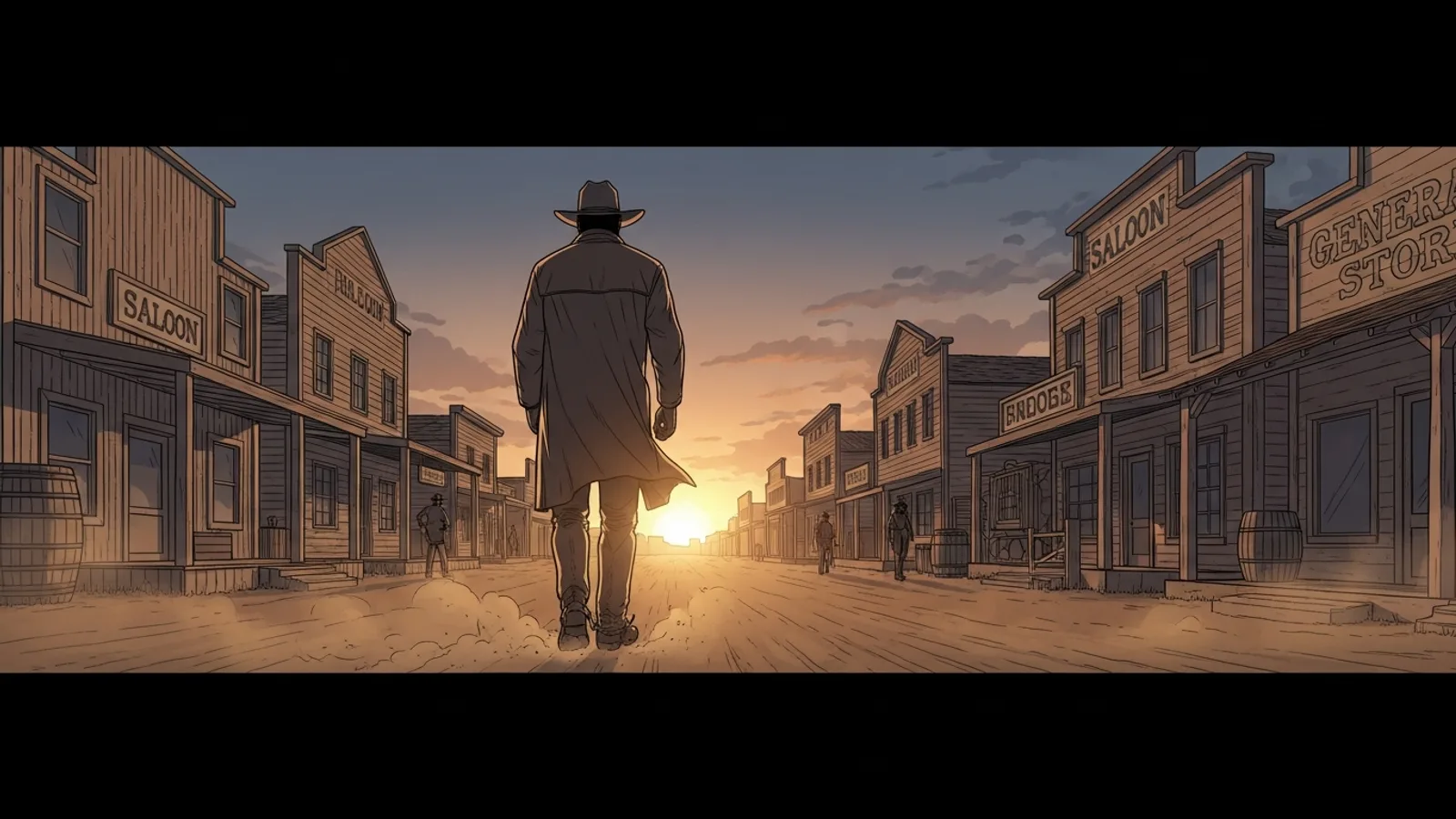
“Exterior, dusty main street of a small frontier town at late afternoon. Wood-plank storefronts on both sides with hand-painted signage. Dust haze at ankle height. Low golden-hour rake light from camera right, long shadows pooling across the street. Single hitching post with a frayed rope, foreground. The protagonist walks in from camera left, duster coat dust-streaked, head down, hat brim shadowing the face.”
The landscape and atmosphere are fully described before the protagonist enters the scene. This is the western frontier convention — the world is older and larger than the protagonist, and the page should communicate that.
Step 3. Generate the page and audit for landscape coherence
Run the page. Beyond standard panel QA, audit specifically for:
- Landscape continuity. Same mesa silhouette, same horizon line, same dust haze density across all panels of the same scene.
- Atmospheric continuity. Golden hour stays golden hour. If the scene takes place over hours, name the time shift in the script.
- Wardrobe weathering continuity. Dust on the duster coat doesn’t appear and disappear between panels.
Per Comistitch internal QA from Q1 2026, painted western pages have a 12-18% panel re-roll rate, comparable to other painted styles. Budget 4-6 minutes per page for QA.
Step 4. Place sparse, period-coded dialogue
Western dialogue runs sparse. A standoff page might have one line; a campfire scene might have three exchanges over six panels. Let the painted landscape carry the mood. Period-coded vocabulary (“obliged,” “much obliged,” “ain’t no call for that,” sparing use of “reckon”) adds register without becoming costume-language pastiche.
Step 5. Export at target format
Western frontier reads well at multiple sizes. Print 300dpi for trade paperback or hardcover; horizontal landscape pages benefit from the painted register. For digital, vertical webtoon scroll works surprisingly well — the format suits the western verticality of canyon walls and tall mesa silhouettes. Publishing guidance for both Webtoon and Tapas platforms is in the webtoon publish guide.
In short: style + bible → landscape-first scripts → generate → landscape audit → sparse dialogue → export. ~16 min per page.
What Are the Common Failure Modes in AI Western?
Three failure modes account for most painted western re-rolls:
The “theme park” failure. The model produces a generic western image — clean clothes, mid-day flat light, decorative saloon. Fix: add weathering vocabulary (dust on every surface, sweat stains, sun-burnt skin) and name the light specifically (golden-hour rake, harsh midday top-down, low blue evening).
The empty-landscape failure. The landscape is rendered but feels stage-set rather than lived-in. Fix: add 1-2 environmental story elements per panel — hitching post with frayed rope, water trough with green algae, weathered missing-persons flyer on a post, abandoned freight wagon at the road edge. Small storytelling props give the landscape weight.
The character drift in panoramic shots failure. Wide-frame panels where the protagonist is small can drift more than tight portraits because the rendering invests less in small figures. Fix: name the silhouette explicitly in every wide-frame prompt (“the protagonist in the grey duster coat and hat, visible at midground”), and pre-generate several hero shots at different distances so the silhouette stays recognizable. The full drift method is in the AI comic character consistency guide.
In short: theme park, empty landscape, drift in wide shots. Prevent with weathering vocab, environmental storytelling props, and explicit silhouette anchoring.
Frequently Asked Questions
What defines the western frontier realistic comic register? Wide landscape, dusty palette, weathered anatomy, high-contrast lighting, atmospheric texture. See What Defines the Western Frontier above.
Which painters and filmmakers shape the lineage? Remington, Leone, Frazetta, Eastwood, Lemire. AI works because the visual rules are consistent across the lineage.
Which Comistitch plan handles western frontier work? Graphic Novel Painted (Pro) is the default. Semi-Realistic for action. Hyperreal for prestige one-shots.
How do I render dust and atmosphere? Name the atmospheric element explicitly in every scene — dust haze, sun glare, heat shimmer, golden-hour rake. See How Does AI Render Painted Western.
Can I publish on Webtoon or Tapas? Yes. Western verticality maps well to scroll format. See the webtoon publishing guide.
Start a Western Frontier Project
If you’re building a painted western graphic novel, serialized frontier story, or one-shot prestige western hardcover, painted realism is your register. Open Comistitch Studio → and select Graphic Novel Painted to start.