Updated May 2026 — Expanded with a full iyashikei cheatsheet table, new prompt do/don’t examples, and a dedicated section on building 50-panel chapters without mood drift.
Iyashikei manga uses soft color, deliberate silence, and unhurried pacing to leave readers feeling genuinely calmer than before they opened the page. To do that with AI, you need three things aligned: a palette that communicates warmth before a single line of story is read, a prompting discipline that never lets the generator escalate tension, and a panel rhythm that breathes. This guide covers all three.
What you will find here: a plain definition of the genre, AI pacing techniques, the exact hex palette used in authentic healing comics, a cheatsheet table, step-by-step chapter-building guidance, and 7 FAQ answers.
In short: Iyashikei manga is defined by an absence of tension rather than a presence of drama. In AI generation, that means writing prompts around comfort objects, natural light, and seasonal textures — not characters in conflict. Lock your palette to sage, cream, and warm beige, then let the builder handle scene continuity automatically.
What defines iyashikei manga’s visual style and atmosphere?
Iyashikei (癒し系) translates roughly as “healing type.” The genre emerged from a cultural counter-response to productivity pressure: stories that deliberately slow down, strip out antagonists, and let the camera linger on a cup of tea getting cold, a cat sleeping in a patch of light, or rain on a window. Classic genre touchstones include Mushishi, with its quiet wandering through rural Japan, and Yokohama Kaidashi Kikou, whose post-scarcity world feels more like an extended exhale than a narrative.
Visually, iyashikei shares a recognizable grammar:
- Open backgrounds — environments are drawn with careful detail but never feel cluttered. Negative space is structural, not lazy.
- Low saturation with warm bias — colors skew toward sage greens, muted ochres, cream whites, and desaturated terracottas. Pure saturated primaries are avoided almost entirely.
- Soft linework — outlines thin out toward edges; backgrounds use looser, sketchier strokes than foreground objects.
- Seasonal light — golden-hour and overcast-day lighting dominate. Harsh midday sun is rare; blue-tinted cold light even rarer.
- Still-life focus — food, tableware, tools, plants, and windows function as emotional anchors in lieu of dramatic action.
Understanding this visual grammar is what separates a genuinely soothing AI-generated chapter from one that just happens to feature a café setting.
How do AI tools maintain calm pacing across slice-of-life sequences?
Pacing in sequential art is managed through panel rhythm: the number of panels per page, the ratio of silent panels to dialogue panels, and how much “time” each panel is allowed to represent. Iyashikei chapters deliberately stretch low-intensity moments and compress high-intensity ones — which in this genre means even minor social friction.
When generating with AI, the challenge is that the model has a natural bias toward legibility. It defaults to clear action, expressive faces, and dynamic compositions — the opposite of what iyashikei requires. You have to override that bias at the prompt level.
Proven panel-rhythm rules for AI generation:
- One silent panel per three dialogue panels — Give the builder explicit instruction to include a reaction or environment panel with no speech bubbles after every short exchange.
- Short-scene segmentation — Break your chapter script into 3–5 panel micro-scenes. Each micro-scene should represent a single sensory moment: arriving at a place, noticing a detail, completing a small task.
- Anchor every scene with a comfort object — Teacup, open book, window light, plant leaf. Tell the builder to reference this object at least once per micro-scene.
- Avoid transition words that signal action — Words like “suddenly,” “immediately,” and “then” push the generator toward energetic compositions. Prefer “later,” “meanwhile,” “quietly.”
- Use weather as an emotional variable — Overcast light softens everything. “Afternoon rain visible through window” is a single phrase that changes the mood of 5 consecutive panels.
Comistitch handles scene continuity from inside the builder automatically — once you establish a room’s lighting in the first panel prompt, the builder carries that lighting reference through subsequent panels in the same scene without you having to repeat it each time. This is particularly valuable for iyashikei, where a single mood shift can break the spell of the entire chapter.
For broader pacing strategy in sequential storytelling — including when to use splash panels and how to manage chapter endings — the webtoon pacing and cliffhanger techniques guide is worth reading alongside this one, even though the techniques run in opposite directions.
What soft color palettes work best for healing manga in AI generation?
Color is the first signal a reader receives before processing a single panel’s composition. In iyashikei, the palette does emotional work that the script never has to do explicitly.
The canonical four-color system for healing manga:
| Role | Hex | Name | Where to use |
|---|---|---|---|
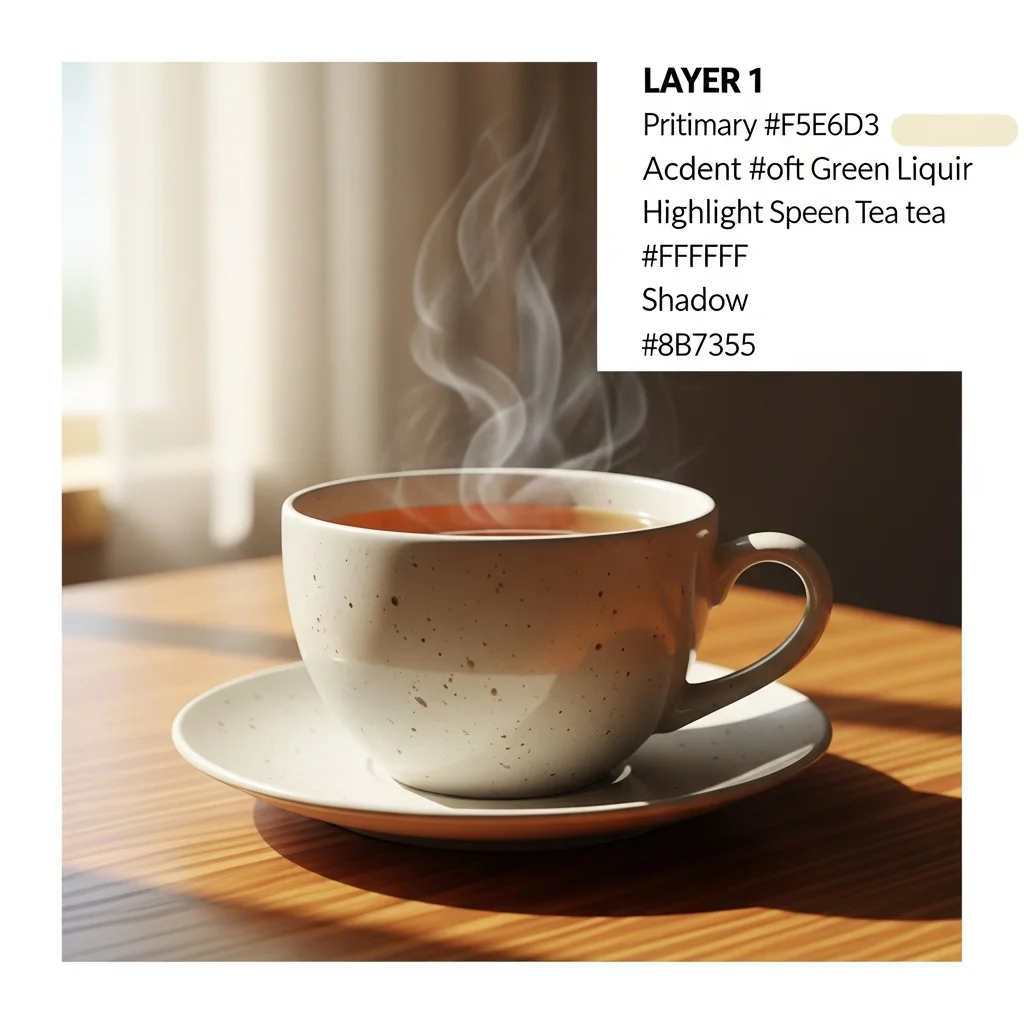
| Dominant | #78A367 | Sage green | Wall tones, foliage, fabric, background fills |
| Secondary | #D4AF9E | Warm beige | Wooden surfaces, skin undertones, paper textures |
| Highlight | #F5E6D3 | Cream | Light sources, curtains, steam, blank page areas |
| Shadow | #8B7355 | Wood brown | Floor depth, shadow fills, furniture legs, outlines |
This palette avoids pure white (too clinical), pure black (too high-contrast), and any saturated accent color. When you need a pop of visual interest, introduce it through texture variation rather than hue shift — a woven basket pattern in #8B7355 reads as warmth, not drama.
For a deeper treatment of color theory in sequential storytelling — including how complementary colors create emotional contrast — the webtoon color palette and mood design guide covers the full framework.
How do you avoid action-heavy prompts when generating iyashikei?
The single most common failure mode when generating iyashikei with AI is writing prompts that read like action manga descriptions. Verbs and nouns carry genre signals: “fights,” “races,” “confronts” all steer the generator toward high-energy compositions even if you never intended drama.
The iyashikei cheatsheet — everything locked in one table:
| Category | Rule / Value | Notes |
|---|---|---|
| Palette anchor | #78A367 sage + #D4AF9E beige + #F5E6D3 cream + #8B7355 wood brown | Add these hex codes verbatim to every scene prompt |
| Lighting keyword | ”diffused golden-hour window light” | Avoid “dramatic,” “harsh,” “stark,” “rim light” |
| Pacing rule | 1 silent panel : 3 dialogue panels | Hard ratio; count panels before finalizing chapter |
| Prompt verbs (DO) | notices, drifts, settles, waits, tends, sips, arranges, observes, unfolds | Low-energy, sensory, process-oriented |
| Prompt verbs (DON’T) | fights, rushes, crashes, confronts, escapes, shouts, lunges | High-energy; trigger action compositions |
| Scene types (DO) | Preparing food, watching rain, reading, tending plants, early morning routine, seasonal change | Grounded, sensory, temporally unhurried |
| Scene types (DON’T) | Arguments, competitions, chases, reveals, climactic moments | Genre-breaking tension signals |
| Panel framing | Medium shot or wider; avoid extreme close-ups on faces | Face close-ups escalate emotional intensity |
| Dialogue density | ≤20 words per speech bubble; ≤2 bubbles per panel | More text = faster perceived pace |
| Background rule | Always include 1 comfort object anchor per scene | Teacup, open window, plant, book, textile |
| Chapter length | 18–24 panels per chapter | Over 30 panels risks tone drift in AI generation |
Prompt example: a correct iyashikei scene
Scene 3 — Tea shop, late afternoon.
Style: soft linework slice-of-life manga. Palette dominant #78A367 sage walls,
accent #D4AF9E wooden counter, highlight #F5E6D3 curtain catching light,
shadow #8B7355 floor boards. Lighting: diffused golden-hour window light from left,
no harsh shadows, warm interior glow.

Panel 1 (establishing, silent): Wide shot of the tea shop interior, one-point
perspective toward back window. Empty wooden counter in foreground. Clay teapot
on a small stand. Steam rising. No people visible.

Panel 2 (medium): A pair of hands around a ceramic cup, sage-green liquid inside,
steam wisps curling upward. Table surface warm beige grain.

Panel 3 (reaction, silent): View out the window — maple branches with two or three
autumn leaves, overcast sky behind them. No dialogue. No speech bubbles.
This prompt keeps energy low through deliberate framing choices: the establishing shot places the reader before anyone speaks, the hands-only medium shot avoids facial expressiveness, and the silent reaction panel gives the reader time to breathe before the next beat. From inside the builder canvas, these three panels will generate with consistent palette and lighting because the scene context is established once and carried forward.
Building a 50-panel iyashikei chapter without breaking mood
Fifty panels is a full-length chapter for serialized manga. At that length, AI-generated content faces real mood-drift risk: the model’s default bias toward legibility and action will accumulate across scenes if left unchecked. Here is a repeatable chapter architecture that keeps the healing tone intact from panel 1 to panel 50.
Chapter structure: five acts of ten panels each
Act 1 — Arrival (panels 1–10): Establish the world. Introduce the physical space through architectural or landscape establishing shots before any character appears. Use 3–4 silent panels. No dialogue until panel 5 at the earliest.
Act 2 — Routine (panels 11–20): A simple task performed with care. Cooking, arranging objects, tending a garden, opening a shop. One comfort object anchors every 3-panel micro-scene. Dialogue light — fragments, observations, no exposition.
Act 3 — Interruption (panels 21–30): The one thing that changes. Keep it gentle: an unexpected visitor, a piece of news, a sudden weather shift. Resist the urge to treat this as a “conflict.” In iyashikei, an interruption is a texture variation, not a plot engine. Dialogue peaks here — two exchanges of 2–3 bubbles each.
Act 4 — Absorption (panels 31–40): The world processes the interruption. Characters return to smaller tasks. The comfort object reappears. Lighting shifts — late afternoon moving toward dusk. Increase silent panel ratio back to 1:3.
Act 5 — Settling (panels 41–50): The chapter’s emotional resolution. Not a climax — a slow exhale. End on a silent or near-silent panel: an empty cup, a closing door, the last light leaving a window. No dialogue in the final two panels.
For the technical craft of planning these beats before generation — how to build a panel-by-panel storyboard that the AI can follow — the manga storyboarding step-by-step guide provides a framework that maps directly onto this five-act structure.
When you have the script ready and want to understand how different panel layouts affect the reading rhythm, the manga paneling 101 with AI guide covers the specific layout types — bleed panels, grid pages, splash frames — and which ones slow reading pace versus accelerate it.
What panel compositions work best for iyashikei scenes?
Composition is the third variable after palette and prompt language. The framing choices you specify directly control how energetic a panel feels.
Compositions that support the healing mood:
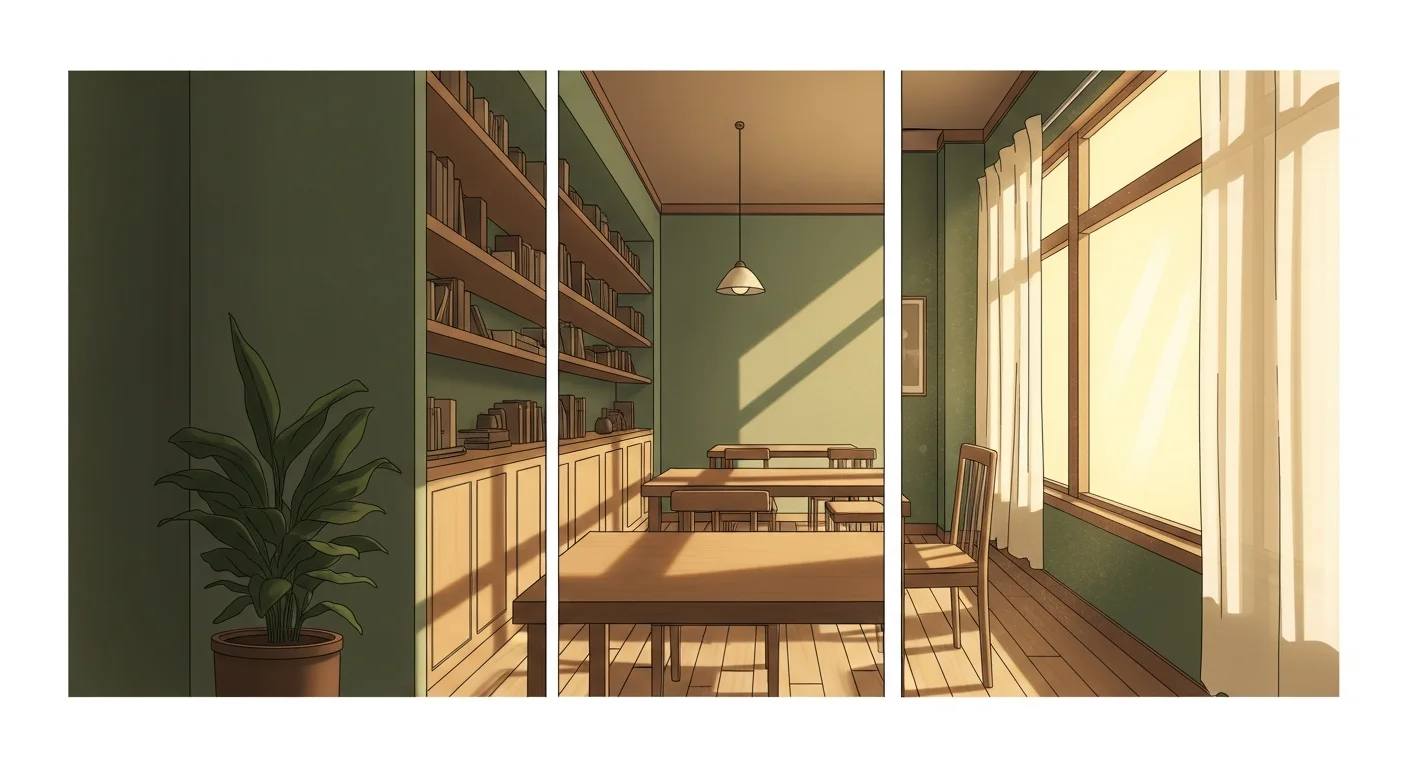
- One-point perspective interiors: A room receding toward a window or doorway. Draws the eye gently to a light source without dynamic tension. Used in establishing shots throughout a chapter.
- Top-down tableaux: Looking down at a table, a desk, an open book with tea. Removes the horizon line and all spatial drama. Purely contemplative.
- Profile-at-window: A character’s silhouette or back, never a full face, looking outward. Keeps emotional temperature low.
- Still-life close-up: The comfort object alone — teacup, plant cutting, a handwritten note. No context beyond the object. Reader projects their own meaning.
- Negative-space landscape: A small figure (or no figure) in a wide natural scene. Distance communicates smallness-within-the-world rather than isolation.
Compositions to avoid in iyashikei:
- Dutch angle / canted frames: Signal unease and psychological tension.
- Diagonal action lines: Push energy upward even in calm scenes.
- Extreme close-up on eyes or mouth: Activates emotional reading at an intensity iyashikei does not want.
- Low-angle hero shot: Makes subjects seem powerful and imposing.
Understanding how these framing choices interact with panel sequence rhythm — the difference between a two-page spread and a six-panel grid — is covered in detail in the manga paneling 101 guide and extended in the webtoon vertical scroll paneling guide for creators building their chapters for digital platforms.
How does character design stay consistent with iyashikei’s gentle aesthetic?
Character design in iyashikei follows the genre’s emotional logic: faces should be readable but not expressive to the point of drama. This means:
- Softer facial features — rounder jaw lines, smaller mouths, less exaggerated eye shapes than shonen conventions
- Restrained expression range — contentment, gentle curiosity, mild wistfulness; avoid shock or intensity
- Clothing that communicates warmth: aprons, loose linen, seasonal layers, worn knits
- Hair that reads as practical rather than stylized; no spiky silhouettes or dramatic color
For AI generation specifically, establishing a character reference early and keeping the descriptor stable across all your prompts is the core discipline. Drift in character appearance across panels breaks immersion faster in iyashikei than in any other genre because readers are paying close attention to small details rather than plot beats.
The manga character design with AI guide walks through the exact process of building a stable character reference — from initial description to style-locking across multiple chapter batches.
Once you have character design under control, the best AI manga generators comparison for 2026 is worth reviewing for an objective look at which tools handle soft-aesthetic linework best — important context if you are evaluating platforms before committing to a chapter project.

How do you write a 60-word scene description that the builder will honor?
The builder reads your scene descriptions and uses them to guide both composition and mood. Sixty words is the practical sweet spot for iyashikei scene prompts: enough context for accurate generation, short enough that no single instruction gets diluted.
A reliable structure:
- Location + time of day (8 words): “Small tea shop interior, late afternoon, overcast light.”
- Palette instruction (10 words): “Dominant sage green walls, warm beige counter, cream curtain highlights.”
- Lighting note (10 words): “Diffused window light from left, no harsh shadows, warm ambient.”
- Main subject (12 words): “Ceramic teacup on wooden counter, steam rising, no people visible.”
- Emotional register (10 words): “Quiet, contemplative, unhurried. Suggest stillness rather than emptiness.”
- What to avoid (10 words): “No dialogue bubbles, no faces, no high-contrast or saturated colors.”
Total: approximately 60 words. The builder handles the visual execution of this description from inside the panel canvas — you focus on the sensory and emotional language, not the technical image parameters.
Frequently Asked Questions
What does iyashikei mean in manga and anime?
Iyashikei (癒し系) is a Japanese genre whose name translates roughly as “healing type.” Stories prioritize emotional comfort and quiet atmosphere over plot-driven tension. The genre emphasizes mundane beauty — meals, seasons, small rituals — to leave readers feeling soothed rather than stimulated.
Which AI tools best preserve a calm, slow-paced mood across panels?
Tools with a sequential story pipeline hold mood best because each panel is generated with shared context from the previous one. Comistitch is designed for this: you pass a chapter script and the builder maintains tone, lighting language, and palette continuity across every scene rather than regenerating from scratch panel by panel.
Should iyashikei avoid dialogue-heavy panels?
Not entirely, but dialogue should feel unhurried. Keep speech bubbles small relative to the panel frame. Silence panels — a single object or landscape with no text at all — are a core visual rhythm device. Aim for roughly one silent panel per every three dialogue panels.
What is the difference between iyashikei and standard slice-of-life?
Standard slice-of-life may include comedic escalation or social conflict. Iyashikei deliberately removes tension. Conflict, when it appears, is resolved gently and quickly. The goal is mood restoration, not story catharsis. Think of it as slice-of-life with the stress filtered out.
Can a sci-fi or fantasy story be iyashikei in tone?
Yes. Genre setting is secondary to pacing and emotional register. A lone explorer cataloguing alien plants, a retired mage running a village bakery, or a small robot tending a greenhouse can all carry an iyashikei mood. The key is that the world itself feels safe and wonder-filled rather than threatening.
How long should an iyashikei chapter be for AI generation?
Aim for 18 to 24 panels per chapter. Iyashikei benefits from breathing room, so resist the urge to pack each page. For AI generation, shorter chapters (under 30 panels) keep tone drift low — the builder has less opportunity to escalate energy as it processes more scenes.
Does Comistitch have a slice-of-life style preset?
Yes. The AI slice-of-life manga style covers the soft linework, open backgrounds, and warm palette conventions used in healing-genre comics. You can select it at the start of a project; the builder then applies consistent visual language across all generated panels automatically.
Start your iyashikei chapter today
The healing power of iyashikei comes from intentional craft decisions: a palette locked to sage, beige, and cream; prompts that reach for silence rather than drama; and a panel rhythm that lets ordinary moments breathe. Those are the same decisions you make upfront before the AI generates a single frame.
Get the style loaded, paste in your first scene description — “small tea shop interior, late afternoon, ceramic teacup on counter, no people, diffused window light” — and let the builder handle the rest. The calm aesthetic you are going for is entirely achievable with the right setup.