You have a crew, a flag, and a course set for the horizon — but no art team. This guide is for builders who want to ship a shonen-style pirate adventure comic AI workflow start to finish, without faking your way through illustration.
In the next 1700 words you’ll get:
- What “shonen pirate” actually means as an art and pacing genre
- A panel-by-panel builder workflow inside Comistitch
- 6 art-direction prompts you can paste straight into the panel canvas
- How to keep a crew of 5+ characters consistent across a chapter
- Where to publish and serialize once chapter one is done
No theory filler. Let’s get into it.
What “Shonen Pirate” Actually Looks Like
Shonen pirate comics are a sub-genre with strict visual grammar. If you skip the grammar, the comic reads as generic fantasy — and shonen readers will scroll past in two seconds.
The defining traits:
- Inking: heavy black fills, confident outlines, no pencil-sketch softness
- Screentone: dot-pattern shading on shadows, sky, and clothing folds
- Faces: exaggerated (wide grins, anime-style shock veins, tear streams during reunions)
- Panels: jagged edges during fights, full-bleed splashes on big reveals, tight 6-grids for dialogue
- Palette: black and white primary, with optional sepia or single-color accent for chapter covers
- Setting cues: tall ships with named figureheads, port towns with mixed architecture, marine officers in pressed white uniforms, bounty posters
The era reference is the Golden Age of Piracy filtered through an anime lens — 1700s ship rigging next to characters with neon hair and impossible weapons. That tonal mismatch is the genre’s signature.
Why an AI Builder Is Well-Suited to This Style
Pirate adventure stories are panel-heavy. A single boarding scene can eat 12 panels. A weekly chapter eats 40 to 60. Drawing that by hand is months of work — which is why most indie creators stall after chapter two.
An AI builder collapses that work into hours, not months. The trade is that you spend less time on linework and more time on direction: writing tight panel scripts, locking character sheets, and reviewing what the model produced. If you’ve ever written for AI comic tools before, the step-by-step how to create comics with AI guide covers the underlying flow.
What the builder is good at:
- Repeating a locked character across dozens of panels
- Switching camera angles without forgetting the costume
- Producing consistent screentone and ink weight across a chapter
- Filling backgrounds (rigging, port crowds, waves) that hand-artists usually skip
What still needs you:
- Story beats and pacing
- Dialogue and crew voice
- Knowing when a fight panel needs a splash page and when it needs a 4-panel rapid grid
The Builder Workflow — Script to Stitched Page
Here’s the actual flow most shonen-pirate creators run inside Comistitch. The same shape applies to other AI manga generator workflows, but pirate stories have specific landmarks worth calling out.
1. Story Beats (15 minutes)
Write the chapter as 8 to 12 beats in plain text. Not panel descriptions — story beats. Example:
- Crew sights a marine vessel at dawn
- Captain calls for evasion, navigator argues for a fight
- Marine ship opens fire, mast cracks
- Captain boards alone via grappling line
- One-on-one duel with marine commander
- Crew arrives, tide turns
- Marine ship retreats, bounty raised
- Cliffhanger: a second sail on the horizon
That’s a chapter.
2. Character Sheet Lock (10 minutes)
Before any panel art, lock each crew member as a frozen prompt block:
Captain: 19, lean, black hair tied back, red bandana, blue coat with gold buttons, sword on left hip, three small scars across right forearm.
Reuse that block verbatim in every panel that includes him. The character consistency AI comic ultimate guide goes deeper, but the short version is: do not paraphrase. Copy-paste the exact same description every single time.
3. Panel Script (45 minutes for a 40-panel chapter)
Convert beats into panels. For each panel write:
- Camera (wide / medium / close-up / over-shoulder / bird’s-eye)
- Subject (which character, in their locked block)
- Action verb (boards, parries, shouts)
- Background (rigging, sea, port crowd, sunset sky)
- Mood (tense, comedic, somber)
This is the slowest part of the workflow. Spend the time. A weak panel script produces weak art no matter how good the model is.
4. Generate, Review, Stitch (60–90 minutes)
Run the panels through the builder. Expect 10–15 percent of panels to need a regenerate — wrong camera, wrong expression, wrong crew member in frame. Fix them one at a time rather than re-rolling the whole chapter.
Then stitch. The comic stitching AI panel assembly guide covers gutter sizing, dialogue placement, and reading-order rules. For shonen pacing, lean on tight gutters during fights and wide gutters around emotional beats.
6 Art-Direction Prompts You Can Paste
These are starter prompts tuned for shonen-pirate panels. Swap the character block for your own locked sheet.
1. Boarding splash (full-bleed): “Wide shot, low angle, captain mid-leap from rigging onto enemy deck, red bandana flying, sword drawn, salt spray, dawn sky, screentone clouds, heavy ink, motion lines from the bottom-left corner.”
2. Crew dialogue (4-panel grid): “Medium shot inside ship galley, three crew at a wooden table, lantern light, screentone shadows, expressive faces, navigator pointing at a chart, comedic tension.”
3. Marine confrontation (close-up): “Extreme close-up on captain’s eyes under the brim of his bandana, single tear of sweat, screentone background with vertical speed lines, jagged panel border.”
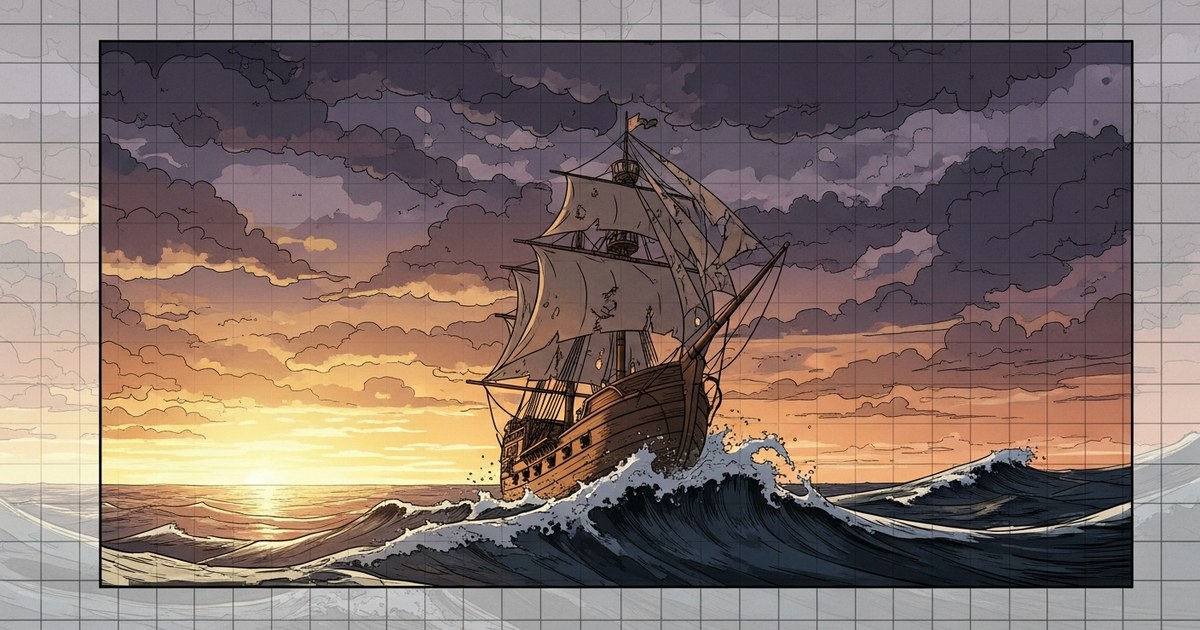
4. Storm at sea (splash page): “Bird’s-eye view of a small ship cresting a massive wave, lightning fork on the right, foam spray, tilted horizon, white foam against deep black sea, dramatic shonen splash composition.”
5. Port town arrival (establishing wide): “Wide establishing shot of a harbor town at sunset, mixed wooden and stone buildings, ship masts in the foreground, crowd of dockworkers, screentone sky, soft sepia accent allowed.”
6. Bounty reveal (insert panel): “Tight insert panel of a weathered bounty poster nailed to a tavern wall, captain’s face center, large bold number, torn corners, single shaft of light from above, harsh shadow.”
Paste, generate, review. Tweak the camera or mood line first if the panel is off — those move the result more than the verb.
Panel Pacing for Action Scenes
Shonen action follows a rhythm western readers don’t usually intuit:
- Setup beat — 1 wide panel showing the field of combat
- Tension beat — 2–3 close-ups, no dialogue, just expressions and stances
- Impact beat — 1 splash or jagged-border panel, often full-bleed
- Aftermath beat — 1 wide panel showing the result, often with screentone smoke or dust
A clean fight beat is roughly 5–7 panels. New creators tend to either compress it into 2 panels (reads rushed) or stretch it past 12 (reads padded). Five to seven. Internalize that.
World-Building Without Character Impersonation
This is the line indie creators forget: the genre is fair game, the IP is not.
Safe to build:
- Tall ships with named figureheads (a wolf’s head, a shattered moon, a flaming kraken)
- Port towns with mixed architecture and a market square
- Marine-style law enforcement in white uniforms with rank insignia
- Devil-fruit-flavored powers if you invent the mechanic and look (not the named fruits)
- Bounty systems, navigator’s logs, sea legends
Not safe:
- Named characters from existing series (no captains in straw hats with the wrong name)
- Direct copies of recognizable crew silhouettes
- Catchphrases or signature poses lifted whole
If a reader can identify your character as “AI version of [famous pirate]” rather than “your character,” the design is too close. Pull back, change the silhouette, change the iconic accessory, change the signature pose.
Keeping the Crew Consistent Across 40+ Panels
| Technique | What it solves | When to use |
|---|---|---|
| Locked character block | Hair, costume, weapon drift | Every panel, every chapter |
| Reference panel | Face geometry drift | Every 8–10 panels, regenerate using a known good panel as reference |
| Costume notes | Wrong-color accent issues | First panel of each new scene |
| Crew grouping prompt | Wrong character in frame | Any panel with 3+ crew |
| Pose-only prompts | Same face, new action | Fight scenes |
The trap most builders fall into: rewriting the character block “to keep it fresh.” Don’t. The model treats every paraphrase as a new character. Boring repetition is the price of consistency.
Where to Publish a Shonen-Pirate Series
Once chapter one is stitched, you have options:
- Webtoon platforms (LINE Webtoon, Tapas) — vertical scroll, weekly cadence, large shonen-action audience. Reformat panels into a single tall canvas before upload.
- Tapas / GlobalComix — accepts traditional page-format manga; better for creators who want page spreads to stay intact.
- Your own site — Astro or Next.js with a chapter index. Slower discovery, full ownership.
- Twitter/X and Bluesky teaser posts — splash pages perform well; full chapter on the platform of your choice.
For workflow comparisons against other styles you might serialize alongside, the AI isekai generator style page covers a related but distinct shonen sub-genre.
FAQ
See the full FAQ in the page metadata for answers on copyright, chapter length, character consistency, and common rookie mistakes.
Ship Chapter One This Week
The barrier to a shonen-style pirate comic was never the story — it was the 200 hours of inking. Comistitch removes the inking. What’s left is the part you actually wanted to do: write a crew worth following and send them somewhere dangerous.
Open the builder, lock your captain, write eight beats, and run the first ten panels. Worst case you learn the workflow in an afternoon. Best case you have chapter one stitched and uploaded by the weekend.
Start free at app.comistitch.com/signup — no credit card, full builder access, your first chapter on us.