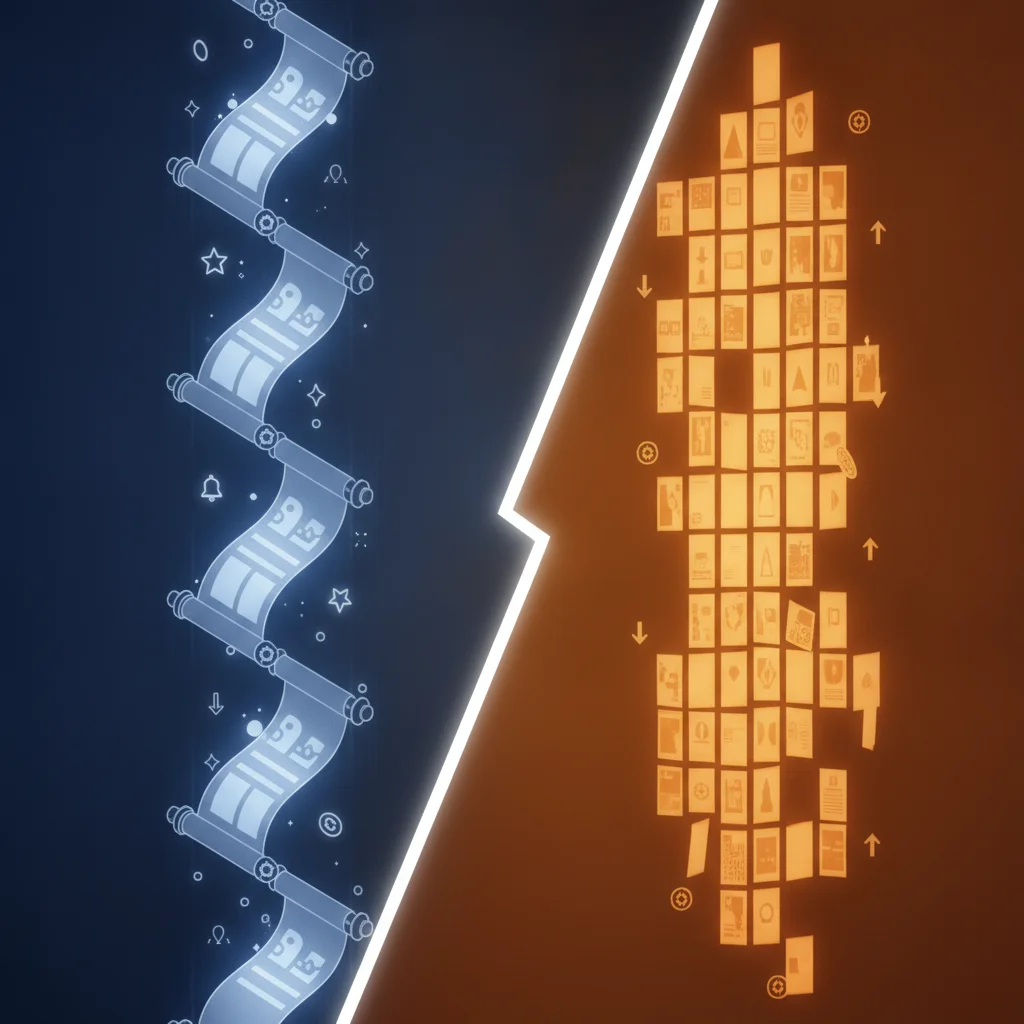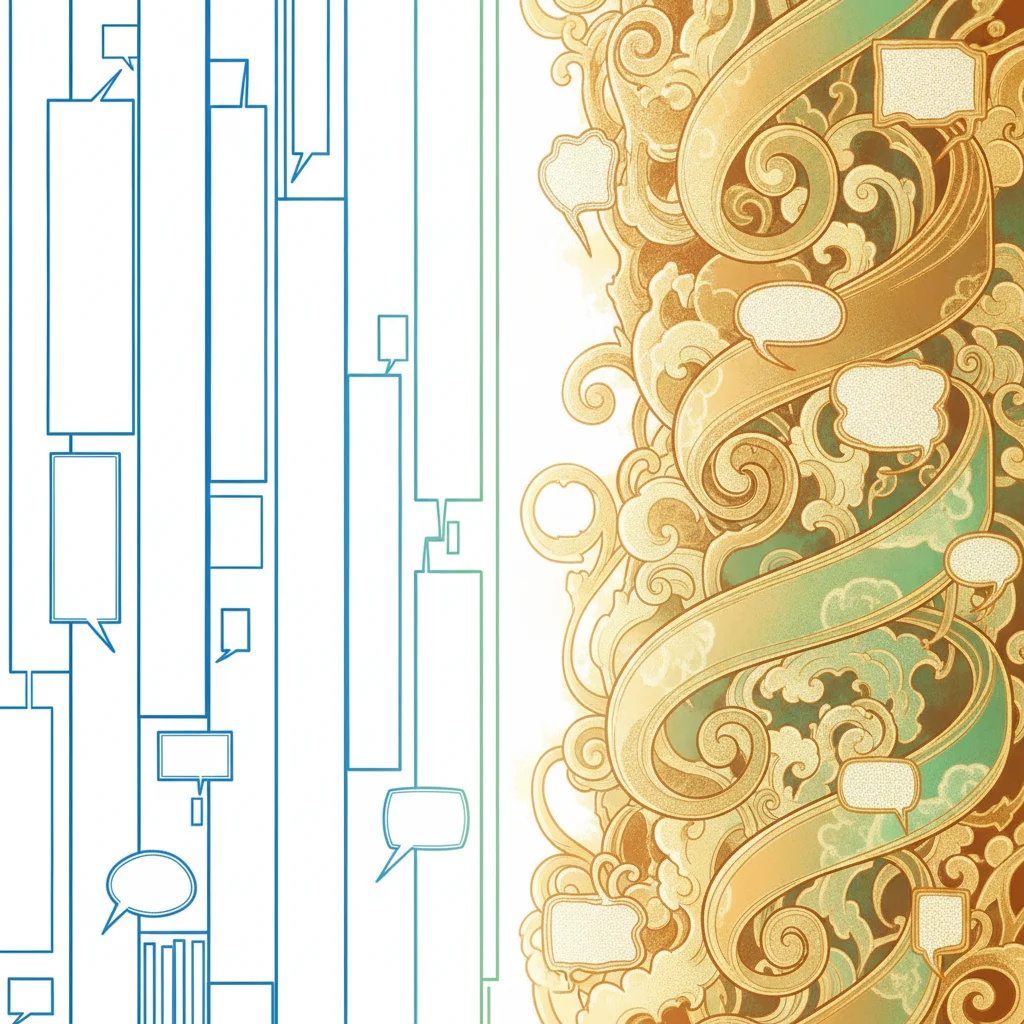
In short: manhwa is Korean, manhua is Chinese. The words mean the same thing — both come from the same Han characters as manga — so the real difference is industrial, not linguistic. Today both publish as full-colour vertical scroll, and you tell them apart by genre logic (murim and regression versus cultivation and xianxia), rendering style (clean line work versus dense gradient and 3D-assisted detail), platform, and what they get adapted into — live-action Korean drama versus donghua animation.
Manhwa vs manhua at a glance
| Manhwa (만화) | Manhua (漫画) | |
|---|---|---|
| Origin | Korea | China, incl. Hong Kong and Taiwan |
| Literal meaning | ”Comics” — same Han roots as manga | ”Comics” — same Han roots as manga |
| Dominant modern format | Full-colour vertical scroll | Full-colour vertical scroll |
| Historic print format | Page-format, often black and white | Page-format; Hong Kong wuxia titles in full colour |
| Reading direction | Top to bottom, left to right | Top to bottom, left to right (older print could run right to left) |
| Signature genres | Murim martial arts, regression revenge, tower/system progression, office romance | Xianxia and wuxia cultivation, palace intrigue, urban cultivator fantasy |
| Art tendencies | Clean line work, hard lighting, character-forward framing | Dense colour gradients, ornate costume and effect detail, frequent 3D-assisted backgrounds |
| Home platforms | Korean portal and studio apps plus their international editions | Chinese comic platforms plus their licensed international apps |
| Screen adaptations | Live-action Korean drama; anime co-productions | Donghua (Chinese animation), often 3D or hybrid |
| Typical cadence | Weekly episodes | Weekly episodes |
This post is strictly about the Korean–Chinese pair. If the question you actually have is how either of them differs from Japanese comics or from the webtoon format, that is a different comparison and we answer it in manhwa vs manga vs webtoon — read that one as the companion to this.
The words mean the same thing
Manhwa (만화 / 漫畫), manhua (漫画) and manga (漫画) are the same two characters read in Korean, Chinese and Japanese. Literally they mean something close to “impromptu sketches” or “rambling pictures”, and in each country the word simply means comics — a Korean reader calls a translated Japanese comic manhwa, a Chinese reader calls a translated Korean one manhua.
The distinction English-speaking readers use is a borrowing convention, not a translation. In English, the three words got assigned to nationality of origin so readers could tell the traditions apart, and then to the house styles those industries happen to produce. That is worth knowing because it explains most of the confusion: you are not comparing two different art forms, you are comparing two comics industries that solved similar problems differently.
What actually differs: five things you can check
1. Genre logic
This is the fastest tell, and it is not about setting so much as about what the protagonist is climbing.
Manhwa runs on measurable advancement inside a defined hierarchy. Murim stories place a fighter inside a martial world of sects and rankings; tower, dungeon and awakening stories add explicit game-like interfaces — levels, stats, quest windows — and the story is the ladder. Regression is the other pillar: the protagonist returns to an earlier point in their life carrying knowledge of a future that wronged them, and the tension is competence plus grievance. Korean romance, separately, is one of the largest vertical-scroll categories anywhere, and it is much more contemporary and workplace-driven than its Chinese counterpart.
Manhua runs on cultivation. Xianxia and wuxia frameworks give the protagonist a spiritual-realm ladder to ascend — qi refinement, breakthroughs, tribulations, immortality — and the conflict is sect politics and destiny as much as combat. Historical palace intrigue is a second large pillar, and urban cultivator stories transplant the same advancement logic into a modern city.
Both traditions share the underlying shape: a weak protagonist becomes formidable through a systematised progression. The furniture differs. If the advancement is stat-flavoured and the world is martial-modern, you are probably reading manhwa; if it is spiritual-realm-flavoured and steeped in immortality mythology, you are probably reading manhua.
2. How the art is made
Manhwa studios trend toward clean, high-contrast rendering: crisp line work, sharply lit faces, strong silhouette reads at phone size, and a colour palette that shifts per scene to carry mood. Panels are character-forward — a lot of close and medium framing, with the vertical gutter stretched to control beat length.
Manhua trends toward density. Colour is layered and gradient-heavy, costume and spiritual effects carry a lot of ornament, and environments get sweeping establishing shots. It is also the tradition where 3D-assisted production is most visible — architecture, crowds and complex costume rendered from models and painted over. Whether that reads as efficient or stiff is a matter of taste, and readers argue about it constantly.
Neither is a rule. There are painterly manhwa and severely minimal manhua. But if you are shown a random page and asked to guess, rendering density is a better predictor than subject matter.
3. Format and reading direction
Both converged on the same answer, and it is worth being precise about why. Korean portals moved comics to the web in the early 2000s and designed for a scrolling browser rather than a scanned page — that is the origin of the webtoon format. Chinese platforms adopted the same vertical column as mobile reading took over.
So: both are read top to bottom, left to right, in colour, on a phone. The right-to-left habit belongs to Japanese manga and to older printed Chinese comics in traditional-character markets, which is where the “is manhua read backwards” question comes from. For anything published digitally in the last decade, it is not.
Print history is the actual difference here. Korean rental-shop manhwa were largely black-and-white page comics; Hong Kong wuxia manhua were full-colour page comics with their own long-running serialisation culture. Both of those traditions still exist and neither is what most English-language readers now mean by the words.
4. Platforms and how chapters arrive
Manhwa publishes through Korean portal and studio apps and their international editions, on a weekly per-episode schedule with coin-based early access and a free back catalogue. Manhua publishes through Chinese comic platforms and their licensed international apps, on a similar weekly, per-episode, freemium model.
The practical consequence for English readers: licensing is the bottleneck, not production. Both industries produce far more than gets officially translated, availability shifts by region, and official apps are where creators actually get paid. Where to read a given title is a question about licences this month, not about the tradition.
5. Adaptation pipelines
A manhua hit’s most likely screen outcome is donghua — Chinese animation, frequently 3D or hybrid 2D-3D, released on domestic streaming platforms, often adapting the web novel and the comic in parallel since a great many manhua are themselves novel adaptations.
A manhwa hit has two routes. Animated adaptations are commonly co-produced with Japanese studios and marketed internationally as anime. The larger commercial route is live-action Korean drama, which has become one of the main reasons Korean comic IP is valuable — a successful series can move from weekly episodes to a streaming drama in a way that has no direct equivalent in the Chinese pipeline.
That difference in exit path quietly shapes the comics themselves: manhwa is often written with a live-action-shaped cast and contemporary setting in reach, while manhua’s fantasy scale assumes animation.
Telling them apart in ten seconds
- Spiritual cultivation, sects, immortality, tribulation? Manhua.
- Status windows, dungeon levels, murim rankings, a regressor? Manhwa.
- Ornate gradient rendering with 3D-looking architecture? Manhua.
- Hard-lit clean line work with contemporary clothes? Manhwa.
- Still unsure? Check the creator credits — the romanisation of the studio and author names settles it immediately.
None of these is definitive alone. Taken together they are right most of the time.
Making one yourself
If you are writing in either tradition, the format decision is already made for you — full-colour vertical scroll — so the real choice is visual grammar and story engine.
For a Korean-flavoured series, lock a small cast with strong silhouettes, keep lighting hard and directional, and let the vertical gutter carry your reveals. The AI manhwa generator style is built around that rendering, and the manhwa script generator drafts episodes in beats sized for scroll pacing. Naming conventions trip most non-Korean writers up first, which is what the manhwa character name generator exists for.
For a Chinese-flavoured series, budget your detail: ornate costume and effect work is the signature, and it is also the thing that collapses a weekly schedule if every panel carries it. Reserve density for establishing and climax panels and keep dialogue panels simpler. The AI manhua generator style targets that gradient-heavy look.
Either way, the thing that decides whether a series survives past chapter ten is character consistency across hundreds of panels, not any single page — the practices in webtoon character consistency with AI apply identically to both, and the publishing side is covered in how to publish manhwa online.
Bottom line
Manhwa and manhua are the same word in two languages, attached by English-speaking readers to two separate industries. They now share a format and differ in what their stories are about, how densely they are rendered, which platforms serialise them, and whether success ends in a live-action drama or an animated series. Read a few of each and the difference stops needing a checklist — but until then, genre engine and rendering density will get you there.
Further reading
- Manhwa vs manga vs webtoon — the companion comparison, covering the Japanese tradition and the webtoon format itself
- Manhwa art style best practices — the rendering conventions in detail
- Manhwa, manhua and webtoon prompt cheatsheet — style vocabulary for each tradition
- Glossary: manhwa · manhua · murim · regression · webtoon · vertical scroll