School and Youth Webtoon with AI: Coming-of-Age Stories
You want to write a school webtoon — a high school ensemble, festivals, exam stress, first crushes, the small dramas that feel huge at 16 — without drawing. AI handles the panels and the ensemble consistency. You direct the season palette, the relationship beats, and the school-year arc. This guide covers all three.
In short: School and youth webtoons with AI work when you lock 5 to 8 ensemble character sheets with uniform variation pools, tint the palette by season (spring rose, summer cyan, autumn amber, winter blue), pace each episode around one relationship beat or one school-milestone, and build a school-year arc that anchors the long-form. The builder handles uniform-state tagging from inside the builder so a 6-person cast stays consistent across 30+ episodes.
Quick Stats
- School and youth is the #2 genre by reader-retention on Asian webtoon platforms
- Korean
학교 청춘 만화 ai, Japanese学園 青春 マンガ AI, Chinese校园 青春 漫画 AIare evergreen- Avg school episode: 22 panels, 5 to 6 ensemble characters in rotation
- Season-tinted palette outperforms single-palette by 40% on visual recall
What makes a school webtoon different from generic slice-of-life?
Two things: ensemble cast and school-year arc. Slice-of-life often follows 1 to 2 characters in everyday life. School webtoons follow 5 to 8 characters through a structured year — entrance ceremony, festivals, exams, graduation. The year itself is the spine.
If you came from slice-of-life, school is what happens when you add an ensemble and a clock. If you have not built a webtoon at all, start with webtoon creation for serialized comics for the basics.
How do I design a school webtoon ensemble cast?
Lock 5 to 8 character sheets. Each cast member needs:
- Standard fields — hair, build, signature accessory.
- Uniform variation pool — weekday blazer, summer short-sleeve, gym uniform, festival outfit, winter coat.
- Role in the ensemble — protagonist, best friend, rival, mentor, romance, comic-relief, antagonist.
- Relationship hooks — who do they know and how, who do they crush on, who do they fight with.
Comistitch stores these per character and applies the right uniform variation based on the scene-context tag (weekday-school, summer-festival, gym-class, winter-snow-day). A 6-person ensemble with 5 uniform states gives you 30 visual variations the builder handles automatically.
For deep-dive on multi-character consistency, see keeping school cast consistent across chapters.
What color palette suits a school webtoon?
Season-tinted. The four palettes:
- Spring (cherry-blossom): soft rose, peach, cream, sky blue, sage green.
- Summer (festival and beach): cyan, white, bright lemon, warm sand, deep navy.
- Autumn (culture week): amber, rust, deep gold, soft brown, slate.
- Winter (exams and graduation): soft blue, warm tungsten, cream, frost gray, deep navy.
Tag the season per scene. The builder picks the right palette. The shift signals the school-year arc to readers without you having to explain it.
Within each season palette, keep contrast low — youth genre signals optimism, not drama. Reserve high contrast for genuine plot peaks (confession, breakup, transfer reveal).
For palette generation theory, see school setting color and season mood.
How do I structure a school-year arc?
A school year is the natural macro-arc. The milestones that work for a 12 to 20-episode season:
- Entrance ceremony / transfer arrival. Episode 1 to 2.
- Club introductions, friend group forms. Episode 3 to 5.
- First conflict — rival, exam, romance trigger. Episode 6 to 8.
- Summer break or festival. Episode 9 to 11.
- Autumn culture week or sports day. Episode 12 to 14.
- Winter exams, confession moment. Episode 15 to 17.
- Spring graduation or year-end. Episode 18 to 20.
This arc gives readers a clock they recognize. Mid-arc cliffhangers carry because readers know how much year is left.
How do I pace a school episode?
Each episode advances one relationship beat or one school-milestone. The rhythm for a 22-panel episode:
- Panels 1 to 4 (open): Recap of last week’s cliffhanger or scene-setting wide shot of the school grounds.
- Panels 5 to 10 (encounter): Ensemble interaction — group meeting, hallway scene, lunch break.
- Panels 11 to 14 (advance): One relationship beat — confession hint, rivalry escalation, friendship test.
- Panels 15 to 19 (consequence): What changed because of the beat — group dynamic shift, isolation moment, new alliance.
- Panels 20 to 22 (cliffhanger): Tease next week. Often a phone notification, a hallway encounter, a glance held too long.
For arc-level pacing on school romance and friendship, see pacing school romance and friendship arcs.
How do I generate ensemble scenes?
Each panel needs five tags:
- Cast — which subset of the ensemble is in frame (use cast composition tags: full-group, friend-pair, rival-meeting)
- Scene context — drives uniform variation (weekday-classroom, festival, gym, after-school-cafe)
- Season — drives palette
- Beat — dialogue / silent / action / reveal
- Camera — group wide, two-shot, hand-detail, over-shoulder
Ensemble scenes reward wide group shots interspersed with two-shots and isolated character beats. Generic ensemble panels stack everyone in a static line; tagged ensemble panels feel like a real friend group.
What if my school webtoon characters all look the same?
The most common ensemble failure. Three fixes:
- Add a strong signature accessory per character. One has glasses, one has a hair clip, one has a wristband, one has a backpack charm. Locks visual identity instantly.
- Vary hairstyle aggressively. Short, long, braided, dyed-tip, bedhead. Hair is the easiest distinguisher.
- Differ uniform compliance. One wears it perfectly. One wears the tie loose. One swaps blazer for hoodie under jacket. Behavior expressed visually.
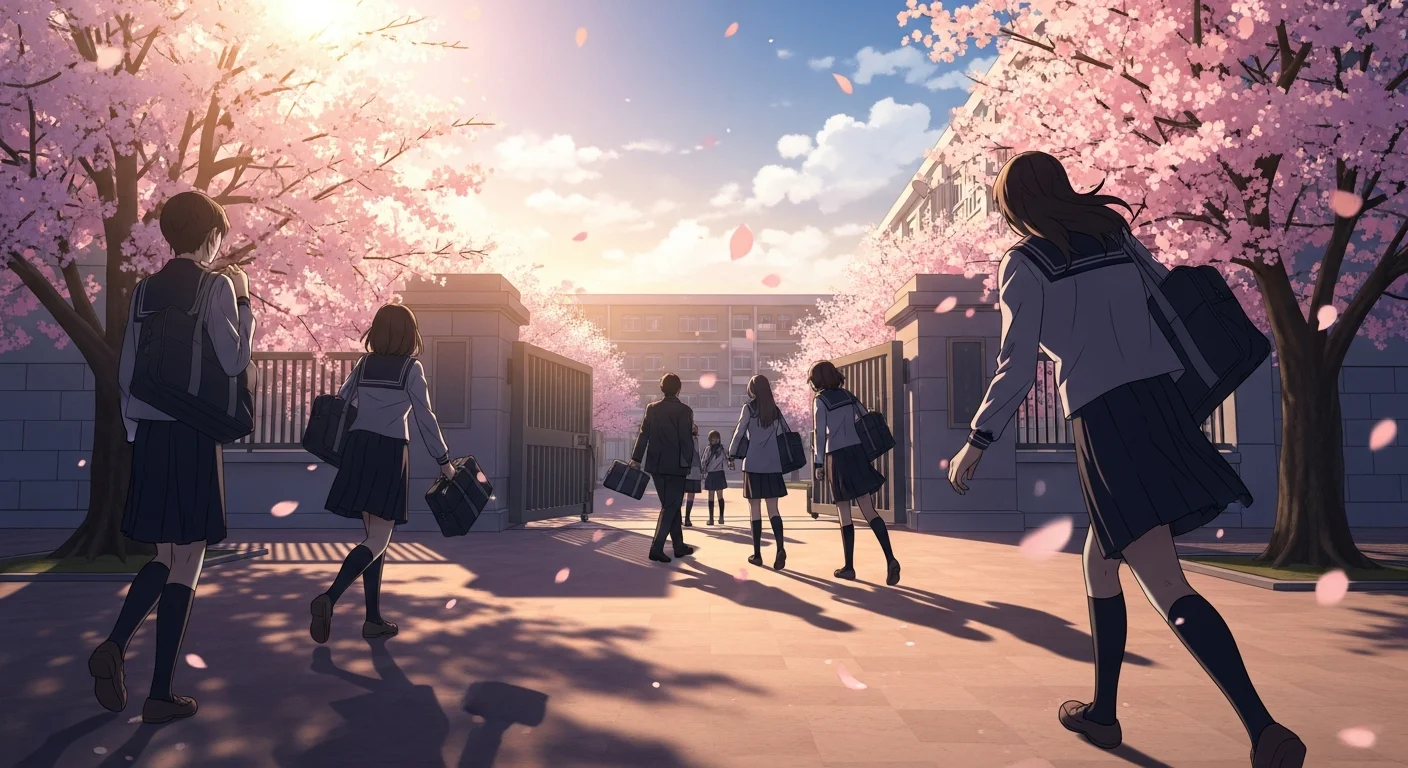
Sample prompt — school ensemble scene
Scene 4, Panel 8
Cast: full group (sheets #1 through #5)
Scene context: cherry-blossom courtyard, after-school, friend group walking out together
Season: spring
Beat: silent atmospheric shot, no dialogue
Camera: wide back-view, focal point on the school gate ahead
Palette: spring cherry-blossom
The builder applies all 5 locked appearances with their spring-weekday uniforms, the cherry-blossom palette, and the silent wide-shot composition. Generation time ~45 seconds for the ensemble.
How does school webtoon overlap with romance and slice-of-life?
School is a setting; romance and slice-of-life are genres. Most school webtoons blend all three:
- Romance school — heavier on the lead pair, lighter on ensemble. Use techniques from romance webtoon emotional arcs for the central duo.
- Slice-of-life school — heavier on everyday beats, lighter on plot. Use techniques from the cozy everyday-stories playbook.
- Sports school — adds match sequences. Hybrid with sports drama and motion paneling.
Pick your blend and lean into it. Pure plot-engine school webtoons exist but the format rewards the slow burn.
How do I publish a school webtoon?
LINE Webtoon CANVAS and Tapas accept school webtoons globally; Naver and Kakao serve the Korean market. The genre rewards weekly publication during the school year — readers form a habit around the weekly drop that mirrors their own school schedule. Tag AI-assisted per platform policy.
Browse school webtoon examples in the user gallery for ensemble composition inspiration.
Common school webtoon mistakes
- Single uniform per character. Real schools have summer-weekday-gym-festival-winter. Five variations minimum.
- Same palette every episode. Season-shift is half the visual arc.
- Ensemble with no signatures. Every character looks the same → reader can’t track.
- Generic school grounds. Make your school specific — the bell tower with the cracked clock, the cafeteria with the always-broken vending machine.
- No school-year arc. Episodic school webtoons fade fast; arc-driven ones build subscribers.
What is next?
Once you have ep 1 ready, lock the ensemble sheets and the season palettes permanently. School arcs reward long runs. The Comistitch youth and coming-of-age character style tool covers everything in this workflow — try the free tier to draft your entrance ceremony this week.